

In light of the recent release of the Federal Reserve’s meeting minutes from January 30–31, 2024, it’s evident that officials have expressed significant caution regarding the prospect of reducing interest rates too quickly. The minutes reveal a consensus among most officials, highlighting concerns that the risks associated with rapid rate cuts outweigh the potential benefits. Despite acknowledging the need for economic stimulus, Fed officials are wary of moving too hastily, fearing that such actions could reignite inflationary pressures and destabilize the economy. This cautious approach reflects the Federal Reserve’s delicate balancing act of supporting economic growth while ensuring price stability.
Whether the FED will achieve this balance remains to be seen.
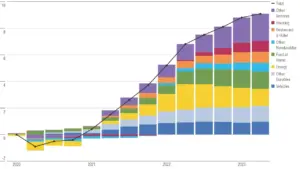
Chart Source: Morningstar | A.J. Arenburg Financial
In reviewing the projections made by Morningstar in 2023 regarding inflation trends and the actual policy actions of the Federal Open Market Committee (FOMC) as observed today, a clear discrepancy emerges. Morningstar had predicted a significant decrease in inflation for 2023, driven by the easing of supply constraints and the Federal Reserve’s interest rate hikes. They anticipated these factors would cool off consumer demand and rectify the durables, energy, and food price surges. However, the current stance and actions of the FOMC suggest that these projections may not have fully materialized as expected.
The Morningstar article’s optimistic forecast underscored the importance of careful analysis and the uncertainty inherent in economic forecasting. While their bottom-up approach provided an industry-specific outlook, aligning with the easing of certain pressures, such as the semiconductor shortage and the anticipated increase in supply chain capacity, the reality today prompts a reevaluation. The FOMC’s ongoing policy measures indicate that inflationary pressures may have been more persistent than initially projected, potentially due to factors underestimated or unforeseen by Morningstar’s analysis, such as sustained disruptions in global trade or labor market tightness.
This divergence highlights the critical need for investors and policymakers to maintain their assessments and not rely solely on external forecasts. It demonstrates the dynamic nature of the economy, where multiple variables can interact in complex and unexpected ways, thwarting even the most informed predictions. It is crucial to continuously monitor economic indicators, FOMC actions, and other relevant data, adapting strategies and expectations to the evolving financial landscape. This approach ensures preparedness for a range of outcomes, allowing for timely adjustments to investment and policy decisions.
A Centered Point of View
Central to the Federal Reserve’s discussion is a commitment to data-driven decisions. The officials acknowledged some progress in curbing inflation but remained wary of acting prematurely.
Is there an over-reliance on data-driven information and what lag effect do economic policies create?
The stance is neither overly hawkish nor dovish, reflecting a pragmatic approach to navigating uncertain economic waters. Federal Reserve officials have shown concern about high inflation persisting, with Chair Jerome Powell highlighting a discrepancy between market expectations for rate cuts and the Fed’s cautious stance. Powell stressed the importance of further data to guide decisions. Although inflation decreased in January compared to previous months, the future remains uncertain, indicating a careful approach to monetary policy adjustments.
The Federal Reserve’s cautious stance reflects a balancing act between acknowledging progress in curbing inflation and remaining vigilant about potential economic risks. Chair Powell’s emphasis on the need for additional data underscores the Fed’s commitment to making informed decisions to ensure economic stability. As inflation trends continue to evolve, the Fed’s approach remains focused on flexibility and adaptability to manage monetary policy effectively.
Biased Views
On one side, there are arguments that maintaining high rates could stifle economic growth while advocating for a quicker adjustment to bolster spending and investment.
Hasn’t the Biden administration already increased spending, leading to inflation? What about the border, Ukraine, and aid to Gaza? Now they want to increase spending even more?
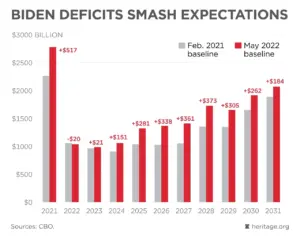
The chart illustrates the projected budget deficits for the United States under the Biden administration from 2021 to 2031. It compares the February 2021 baseline projections against the May 2022 baseline projections. In 2021, the deficit was lower by $20 billion compared to the February 2021 baseline. From 2022 to 2031, each year shows an increase in deficit projections in May 2022 compared to the earlier estimates, with the largest increase of $517 billion in 2022 and the smallest increase of $151 billion in 2024. The source of the data is the Congressional Budget Office (CBO), and the chart is provided by heritage.org. | A.J. Arenburg Financial Research
Conversely, there are cautions against a too-rapid decrease, fearing a reignition of inflationary pressures and advocating for a more conservative path. The left emphasizes Federal Reserve officials’ concerns regarding the potential disruption to progress in reducing U.S. inflation, highlighting strong growth in spending and hiring as key factors. It underscores the decision to keep the key rate unchanged and projects three rate cuts starting in May or June. The center reflects on the cautious optimism among Federal Reserve officials about inflation, noting their reluctance to raise interest rates. It mentions Fed Chair Jerome Powell’s pushback on market expectations of a rate cut in the spring. It emphasizes the need for greater confidence in decreasing inflation before any rate adjustments. There are conflicting reports regarding when cuts will start, and questions have been raised about the transitory nature of inflation.
Global supply chain disruptions have caused sticky inflation and core inflationary drivers have been increasing over time. This leads to skepticism about whether “transitory” is an accurate term for the US economy or if it is simply a tool used to deceive people?
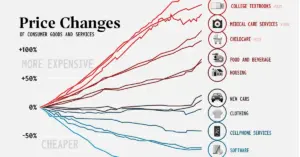
Chart Source: Visual Capitalist | Data for January 2000-2022
The right echoes Federal Reserve officials’ concerns about disruptions to progress in reducing inflation due to strong growth in spending and hiring. It emphasizes the majority of officials’ cautious approach to cutting the benchmark interest rate too soon and underscores the importance of upcoming economic reports in the Fed’s future decisions.
Thoughts
The Federal Reserve’s meeting minutes from late January 2024 have conveyed a marked sense of prudence about the potential downsides of swiftly decreasing interest rates. This cautionary tone aligns with the careful deliberations within the Fed, as they consider the adverse effects that premature rate cuts could have, especially the risk of reigniting inflationary tendencies. Although there’s recognition of the need to inject stimulus into the economy, the Fed’s overriding concern is to avoid destabilizing the progress made in inflation reduction. Such a judicious stance encapsulates the Federal Reserve’s tightrope walk between nurturing economic growth and maintaining price stability, with the ultimate outcome still hanging in the balance.

Reflecting on Morningstar’s 2023 inflation predictions alongside the FOMC’s current policies brings to light a notable divergence. Morningstar’s analysis anticipated a substantial deflationary shift, propelled by relaxed supply bottlenecks and decisive rate hikes by the Federal Reserve. These predictions, suggesting a cooling of consumer demand and price normalization across various sectors, have not entirely come to fruition based on the FOMC’s ongoing efforts. Inflation has proved more resilient than Morningstar predicted, potentially due to persistent global trade interruptions or a tighter labor market than anticipated. This mismatch underscores the imperative for investors and policymakers to form their independent assessments, taking into account the fluidity and unpredictability of economic conditions. Constant vigilance over economic indicators and FOMC policies is essential to refine strategies and make informed decisions in a dynamic financial environment.
In the broader discourse, there’s a dichotomy of opinions. On one end, arguments are made for the reduction of high-interest rates to foster economic expansion. On the opposite spectrum, concerns are raised about the possible resurgence of inflation with too rapid a reduction in rates, with some advocating for a more conservative trajectory. This bifurcation of views accentuates the intricate challenges faced by the Federal Reserve in steering monetary policy amid economic headwinds and evolving fiscal landscapes. As the Federal Reserve continues to navigate these complexities, stakeholders remain attentive to their balanced, data-driven approach to policy modulation, with an emphasis on caution and the need for a comprehensive understanding of the evolving economic climate before initiating rate reductions. The Federal Reserve’s circumspection in rate adjustments is a testament to the complexities and uncertainties inherent in managing monetary policy during challenging economic times.
About A.J. Arenburg Financial

A.J. Arenburg Financial, a Florida-based firm, specializes in investment banking and advisory services for the industrials, healthcare, and technology sectors. We prioritize complex transactional due diligence and serve as a trusted intermediary and partner to family offices, private wealth management firms, boutique private equity firms, and generational organizations with revenues exceeding $10 million. We focus on exit strategies for family-owned businesses with a succession plan or without succession plans.
In addition, our integrated services provide clients with control and transactional cost mitigation. Leveraging our extensive legal and tax network, we offer comprehensive financial advisory services, facilitate acquisition strategies, and deliver full-service assistance for mergers and acquisitions. Our approach combines investment opportunities with corporate finance advisory, including financial, commercial, operational, and technical due diligences, alongside strategic transaction advisory.
Disclosure
The information provided by A.J. Arenburg Financial is for educational purposes only and does not constitute investment advice. Our analysis, views, and opinions are based on assessments made at the time of publication and are subject to change without notice. We do not recommend buying, selling, or holding any specific securities.
Investors should seek advice from their financial advisors before making any investment decisions. A.J. Arenburg Financial and its analysts are not registered investment advisors and do not offer personalized investment advice. Any investment decisions made based on this information are solely the responsibility of the reader.
This report does not guarantee profit or limit losses, and past performance is not indicative of future results. Investing in securities carries inherent risks, and readers should carefully evaluate the risks and benefits of any investment decision.
A.J. Arenburg Financial and its affiliates, directors, officers, or employees bear no responsibility for investment decisions made based on this report. By using this document, the reader agrees to release A.J. Arenburg Financial from any liability associated with its use.
🌐 Sources
- usbank.com – Federal Reserve Focuses Monetary Policy on Fighting
- tellerwindow.newyorkfed.org – Examining the Recent Inflation Episode, the Fed’s Response
- cnbc.com – Fed approves hike that takes interest rates to the highest level
- bankrate.com – 6 key ways the Federal Reserve impacts your money
- cnbc.com – Fed meeting November 2023: Fed holds rates steady
- Why We Expect Inflation to Fall in 2023