
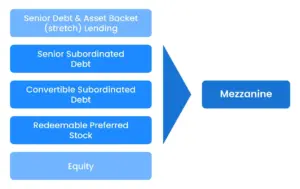
Mezzanine financing, colloquially termed “Mezz” debt, serves as an integral component within the capital structure, often employed in leveraged buyouts. Positioned between senior debt obligations and equity interests, mezzanine financing is subordinate to senior debt instruments but takes precedence over convertible subordinated debt and redeemable preferred stock in the capital recovery sequence.
As a blend of debt and equity, mezzanine financing’s return profile is heightened due to its subordination and uncollateralized nature. Its structure may include equity-related options such as warrants, which confer the right to convert the debt into equity at future dates, offering additional value to investors.
Subordinated Debt vs Convertible Subordinated Debt (Mezzanine)
While sharing subordination traits, mezzanine debt and subordinated debt differ notably. Mezzanine debt’s equity conversion options elevate its expected returns to compensate for increased risk, distinguishing it from traditional subordinated debt. This convertible feature makes mezzanine debt appealing for businesses seeking flexible financing coupled with the potential for higher returns, albeit with greater inherent risk.
- Subordinated Debt ~ Ranking below other debts during liquidation, subordinated debt lacks equity conversion rights, which can lead to higher
interest rates due to the elevated risk profile. - Convertible Subordinated Debt (Mezzanine) ~ Mezzanine debt’s combination of debt and equity, including conversion options, may result in
significant returns for investors upon successful equity conversion events such as IPOs. The associated risk, however, is balanced by the
conversion potential.
Preferred Stock vs Redeemable Preferred Stock (Mezzanine)
Redeemable Preferred Stock, frequently utilized in mezzanine financing, embodies a hybrid nature, combining attributes of both debt and equity instruments. Similar to traditional preferred stock, it offers fixed-income-like characteristics, such as regular dividend payments. However, what distinguishes redeemable preferred stock is its redeemable feature, allowing the issuing company to repurchase the stock at a predetermined price or within a specified period. This redemption feature grants the issuing company flexibility in managing its capital structure and provides investors with an additional layer of security. Moreover, while redeemable preferred stock offers the stability of fixed-income investments, it also holds the potential for equity appreciation, thus appealing to investors seeking a balance between income generation and capital growth within their investment portfolios.
Economic Considerations
Favoring debt over equity is common due to debt’s cost-efficiency, with tax-deductible interest payments reducing taxable income and tax liabilities. In mezzanine financing, particularly with non-amortizing structures, interest obligations are high until the principal is paid at term-end. The equity conversion potential through warrants adds a strategic component to financial planning.
The diagram provided illustrates the position of mezzanine debt

within the capital structure. It showcases the correlation between risk level and expected returns across various financing layers, highlighting mezzanine debt’s unique placement.
The complexity of mezzanine financing and other debt instruments demands informed decision-making, often through investment banking professionals’ guidance. Companies must understand the nuances of interest accumulation, risk management, and strategic financing to navigate growth capital expansion effectively.
In-depth knowledge of these financial mechanisms is crucial for companies seeking to expand strategically and manage capital proficiently. Professional advice is key in ensuring that companies can adeptly handle the intricacies of such complex financial landscapes.
About A.J. Arenburg Financial

A.J. Arenburg Financial, a Florida-based firm, specializes in investment banking and advisory services for the industrials, healthcare, and technology sectors. We prioritize complex transactional due diligence and serve as a trusted intermediary and partner to family offices, private wealth management firms, boutique private equity firms, and generational organizations with revenues exceeding $10 million. We focus on exit strategies for family-owned businesses with a succession plan or without succession plans.
In addition, our integrated services provide clients with control and transactional cost mitigation. Leveraging our extensive legal and tax network, we offer comprehensive financial advisory services, facilitate acquisition strategies, and deliver full-service assistance for mergers and acquisitions. Our approach combines investment opportunities with corporate finance advisory, including financial, commercial, operational, and technical due diligences, alongside strategic transaction advisory.
Disclosure
The information provided by A.J. Arenburg Financial is for educational purposes only and does not constitute investment advice. Our analysis, views, and opinions are based on assessments made at the time of publication and are subject to change without notice. We do not recommend buying, selling, or holding any specific securities.
Investors should seek advice from their financial advisors before making any investment decisions. A.J. Arenburg Financial and its analysts are not registered investment advisors and do not offer personalized investment advice. Any investment decisions made based on this information are solely the responsibility of the reader.
This report does not guarantee profit or limit losses, and past performance is not indicative of future results. Investing in securities carries inherent risks, and readers should carefully evaluate the risks and benefits of any investment decision.
A.J. Arenburg Financial and its affiliates, directors, officers, or employees bear no responsibility for investment decisions made based on this report. By using this document, the reader agrees to release A.J. Arenburg Financial from any liability associated with its use.

🌐 Sources
- viewpoint.pwc.com – Classification of preferred stock
- viewpoint.pwc.com – Preferred stock
- findventuredebt.com – Mezzanine Financing (Mezzanine Debt): The Guide for …
- sec.gov – Temporary Equity Disclosure [Abstract]
- investopedia.com – Mezzanine Financing: What Mezzanine Debt Is and How It Works
- corporatefinanceinstitute.com – Mezzanine Financing – Overview, Rate of Return, Benefits
- dealroom.net – Mezzanine Financing 101: Definition, How it Works (2023)
- investopedia.com – Mezzanine Debt: What It Is, How It Works, and Examples
- ipohub.org – Mezzanine Loans
- vintti.com – Mezzanine Debt vs Senior Debt
- Attract Capital – Mezzanine Debt and Preferred Equity Program
- PwC – Classification of preferred stock
- Terrydale Capital – What You Need to Know About Mezzanine Debt and Preferred Equity
- lev.co – Preferred Equity vs Mezzanine Debt: What’s the Difference?
- SEC.gov – Common Stock, Redeemable Convertible Preferred Stock