
The 2024 U.S. presidential election is poised to significantly impact supply chains, particularly within the industrials and manufacturing sectors. Historical trends and recent global disruptions underscore the importance of understanding potential policy changes and their implications for business operations.
Here are three (3) critical areas of focus
1. Trade Policy and International Relations ~ The election could bring shifts in trade policies and international relations, affecting the cost and flow of goods. Depending on the candidates’ platforms, changes in tariffs, trade agreements, and foreign policy could either facilitate or hinder international trade, directly impacting supply chain costs and efficiencies.
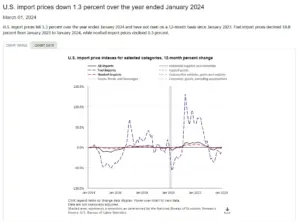
The data and graph above indicate a notable trend in U.S. import prices, which could serve as an important barometer for trade policy and the economic effects of international relations.
Over the year ended January 2024, U.S. import prices decreased by 1.3 percent, marking a continuous year-on-year decline since January 2023. This downward movement is particularly pronounced in the fuel import sector, which saw a substantial drop of 10.8 percent. The decline in nonfuel import prices was more moderate at 0.3 percent. These figures suggest a potential easing of costs associated with international trade for U.S. businesses, which could reflect the effects of recent trade policies or shifts in global market dynamics.
“It’s important to consider how these changes in import costs could influence supply chain decisions and strategies, particularly for industries heavily reliant on imported goods. The implications of this data are critical for stakeholders, the altered landscape of trade costs, and international relations to maintain competitive positioning in the market.”
Several factors are highly dynamic, such as fluctuations in fuel prices, tax implementation policies, and tariffs, which are amplified during the election year. Furthermore, election years tend to bring volatility to the market, creating an ideal setup for locking in the price of futures contracts on commodities to protect and mitigate margin control for transportation supply chain-dependent entities. This strategy can be helpful for such entities to manage their costs efficiently.
2. Infrastructure and Regulatory Changes ~ Infrastructure development and regulatory changes are also key areas that might be influenced by the election’s outcome. Both parties recognize the need for infrastructure improvements, which could enhance transportation efficiency and reduce logistics costs.
“However, differences in funding priorities and regulatory approaches could affect the speed and focus of these developments, impacting supply chain strategies.”
3. Labor Laws and Workforce Availability ~ Changes in labor laws and immigration policies could affect workforce availability, particularly in sectors reliant on manual labor, such as warehousing and distribution.
Labor laws and immigration policies are pivotal in shaping workforce availability, with considerable impact on sectors that depend heavily on manual labor, such as warehousing and distribution. The trend observed in the GSCPI could imply that recent changes in these areas are beginning to positively influence the fluidity and efficiency of supply chains. For instance, if new labor laws have increased the labor pool or made it more flexible, businesses may find it easier to staff roles crucial for the smooth operation of the supply chain. Similarly, immigration policies that allow for a steady flow of workers can address labor shortages and reduce supply chain pressures.
These improvements in workforce availability are essential for maintaining a robust supply chain, ensuring that goods are distributed efficiently to meet consumer demands. Thus, monitoring the GSCPI can provide businesses with insights into the current state of the supply chain and help them anticipate the effects of legislative changes on their operations.
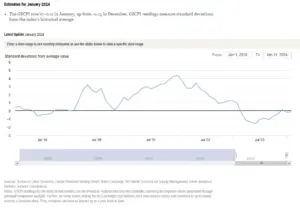
The graph above visually represents the Global Supply Chain Pressure Index (GSCPI) trends leading up to January 2024. Notably, the GSCPI experienced a slight improvement in January 2024, rising to -0.11 from -0.15 in December, indicating a movement closer to the historical average.
“This metric suggests some easing of the pressures on the global supply chain, which could be attributed to various factors, including labor laws and workforce availability adjustments. The election outcome will most likely influence labor market dynamics, with potential effects on production costs and supply chain efficiency.”
According to FreightWaves, as of February 2024, the anticipation surrounding the election has already introduced additional stresses on U.S. supply chains, highlighting the critical need for companies to adapt to potential policy changes.
This sentiment is echoed by insights from LinkedIn, where the emphasis is placed on the necessity for businesses to closely monitor political decisions that could significantly affect trade agreements, tariffs, and market conditions.
Bart De Muynck, in his FreightWaves article dated February 23, 2024, articulates the compounded effects of recent global disruptions and the election year’s uncertainties on the supply chain sector. This year, marking the 60th quadrennial presidential election scheduled for Tuesday, November 5, businesses are bracing for the impact of potential leadership changes and their consequent policies.
Drawing on historical data and the events of 2023, it’s evident that political shifts have the capacity to instigate significant disruptions in supply chains, affecting everything from trade policies to labor laws. The ongoing global challenges and the election’s outcomes necessitate a proactive approach to risk management and strategic planning for industrials and manufacturing businesses.
- Stay informed about the candidates’ platforms, anticipate possible policy
shifts, and employ risk management tools to navigate the election’s potential impacts on supply chains. - The integration of digital innovation and simulation tools emerges as a strategic response, enabling companies to prepare for various scenarios and maintain resilience amidst uncertainty.
Businesses in the industrials and manufacturing sectors should closely monitor the election’s progress, prepare for a range of scenarios, and develop flexible strategies to navigate the changing landscape. Leveraging risk management solutions and simulation tools can aid in scenario planning, helping companies anticipate and mitigate potential disruptions.
Beyond Predictability
The Unforeseen Ripple Effects of the 2024 Presidential Election on Global Supply Chains.

The 2024 presidential election is poised to significantly influence global supply chains, with potential shifts in trade policies, regulations, and economic strategies on the horizon. Analysis from FreightWaves, LinkedIn, and other sources highlights the critical need for businesses to stay vigilant and adaptable to navigate the uncertainties presented by the election year. Political decisions and leadership changes can profoundly affect trade agreements, tariffs, market conditions, and the overall operational landscape for industries reliant on robust supply chains, including manufacturing and e-commerce logistics.
As the world anticipates the outcomes of this pivotal election, companies are advised to closely monitor policy developments and prepare for a range of scenarios. Employing risk management strategies and leveraging technology for supply chain resilience will be essential in mitigating potential disruptions. The 2024 election underscores the intricate relationship between politics and supply chain management, emphasizing the importance of proactive planning and adaptability in an ever-evolving global market.
About A.J. Arenburg Financial

A.J. Arenburg Financial, a Florida-based firm, specializes in investment banking and advisory services for the industrials, healthcare, and technology sectors. We prioritize complex transactional due diligence and serve as a trusted intermediary and partner to family offices, private wealth management firms, boutique private equity firms, and generational organizations with revenues exceeding $10 million. We focus on exit strategies for family-owned businesses with a succession plan or without succession plans.
In addition, our integrated services provide clients with control and transactional cost mitigation. Leveraging our extensive legal and tax network, we offer comprehensive financial advisory services, facilitate acquisition strategies, and deliver full-service assistance for mergers and acquisitions. Our approach combines investment opportunities with corporate finance advisory, including financial, commercial, operational, and technical due diligences, alongside strategic transaction advisory.
Disclosure
The information provided by A.J. Arenburg Financial is for educational purposes only and does not constitute investment advice. Our analysis, views, and opinions are based on assessments made at publication and are subject to change without notice. We do not recommend buying, selling, or holding any specific securities.
Investors should seek advice from their financial advisors before making any investment decisions. A.J. Arenburg Financial and its analysts are not registered investment advisors and do not offer personalized investment advice. Any investment decisions made based on this information are solely the responsibility of the reader.
This report does not guarantee profit or limit losses, and past performance is not indicative of future results. Investing in securities carries inherent risks, and readers should carefully evaluate the risks and benefits of any investment decision.
A.J. Arenburg Financial and its affiliates, directors, officers, or employees bear no responsibility for investment decisions made based on this report. Using this document, the reader agrees to release A.J. Arenburg Financial from any liability associated with its use.

🌐 Sources
- freightwaves.com – The 2024 presidential election may have a big impact on
- linkedin.com – Anticipating the Impact of the 2024 Presidential Election
- finance.yahoo.com – The 2024 presidential election may have a big impact
- czapp.com – 2024 Elections and their Impact on Food Supply Chain
- U.S. import prices down 1.3 percent over the year ended January 2024
- GSCPI readings measure standard deviations from the index’s historical