
Alpha is a pivotal concept in investment analysis. It refers to an excess return garnered beyond a benchmark or market average. It represents the additional gain achieved through skillful investment strategies, indicating the effectiveness of active management in surpassing market expectations.
Visual aids such as line graphs contrasting a portfolio’s performance against a benchmark index over time can vividly illustrate the concept of alpha. Additionally, bar charts comparing the historical alpha of various investment managers or funds can provide a clear comparative analysis, helping investors identify those with consistently superior performance.
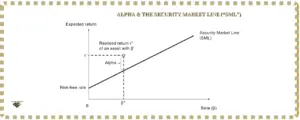
Positive alpha indicates that an investment has surpassed the market’s performance, suggesting the manager’s approach involves skill or unique insights. Conversely, negative alpha suggests underperformance compared to the benchmark, prompting investors to reconsider their investment decisions or explore alternative strategies. The Security Market Line (SML) visual above reflects a security’s expected return based on its systematic risk, measured by beta, relative to the market return. Investors use the Capital Asset Pricing Model (CAPM) to compare expected returns with actual returns, enabling them to determine if security has produced alpha, indicating superior performance, or has underperformed relative to its anticipated return.
Understanding Alpha and Its Practical Utility
Control of Danger ~ The Fund Manager
By measuring the effectiveness of a mutual fund manager or investment technique, alpha allows investors “to an extent” to assess whether the returns achieved are due to skillful management or simply mirroring market performance. Utilizing alpha in conjunction with risk measures such as beta enables investors to gauge both the potential for excess returns and the systematic risk exposure of their investments. However, as with any financial analysis, the model is only as good as the accuracy of its input data. The old phrase, “Garbage in equals Garbage out,” underscores the importance of quality data in generating meaningful insights from financial models.
Relative Return ~ Alpha vs. Beta
Alpha measures the abnormal rate of return on a security or portfolio beyond what would be expected by an equilibrium model like the Capital Asset Pricing Model (CAPM). While beta quantifies the systematic risk of a security or portfolio compared to the market, alpha focuses on the excess return generated irrespective of market movements. For instance, a tech stock may exhibit a beta greater than 1, indicating higher price volatility relative to the market, while its alpha reflects the additional return earned beyond this volatility.
The Capital Asset Pricing Model (CAPM) is a fundamental tool in finance used to estimate an investment’s expected return. It provides a framework for understanding the relationship between an asset’s expected return and its systematic risk relative to the overall market. CAPM assumes rational and risk-averse investors who seek to maximize returns while minimizing risk.

In simpler terms, the CAPM formula calculates the asset’s expected return E[ri]) by adding the risk-free rate (rf) to the product of its beta (βi) and the market risk premium E[rm]−rf). Beta measures the asset’s sensitivity to market movements, with values above 1 indicating higher volatility. The market risk premium represents the additional return investors expect for bearing systematic risk compared to a risk-free investment.
In summary, CAPM provides a systematic method for estimating asset returns based on risk and return characteristics, guiding investors in portfolio construction and asset allocation decisions.
Security Market Line (SML) Data
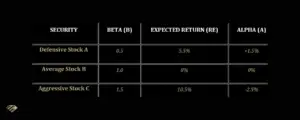
To illustrate the concept of the Security Market Line (SML) and its relationship with alpha and beta, we can provide hypothetical data points based on a fictional scenario.
- Market Return (Rm):: 8%
- Risk-Free Rate (Rf):: 3%
- Beta (β) Range ~
- Low Beta (Defensive Stocks:: 0.5
- Medium Beta (Average Market Risk):: 1.0
- High Beta (Aggressive Stocks):: 1.5
Expected Return (Re) ~ Calculated using the Capital Asset Pricing Model (CAPM) formula:
- Re = Rf + β(Rm – Rf)
Alpha (α) is the Difference between the actual and expected returns based on the SML.
Sources of Alpha
In the pursuit of alpha, investors often explore various avenues to generate excess returns beyond market benchmarks. Active investment decisions, including stock picking and market timing, play a crucial role in uncovering alpha opportunities. By carefully selecting individual securities or timing market movements, investors aim to outperform passive index investing strategies. Additionally, identifying and capitalizing on market inefficiencies and mispricings can contribute significantly to alpha generation. These inefficiencies may arise due to investor behavior, information asymmetry, or temporary market dislocations.
Strategies for Pursuing Alpha
Investors employ a diverse range of strategies to pursue alpha, each with its own set of advantages and challenges. Active management entails hands-on portfolio management, where fund managers actively buy and sell securities to outperform the market. While active management offers the potential for higher returns, it also involves higher fees and the risk of underperformance. On the other hand, passive index investing seeks to replicate the performance of a specific market index, offering low costs and broad market exposure but potentially limiting alpha generation.
Alternative investment strategies provide additional avenues for pursuing alpha. Value investing focuses on identifying undervalued securities trading below their intrinsic value, while growth investing targets companies with high growth potential. Quantitative models utilize mathematical algorithms and data analysis techniques to identify investment opportunities based on predefined criteria. Each strategy comes with its risk-return profile, requiring careful consideration and evaluation before implementation.
Measuring and Evaluating Alpha
Measuring the performance of alpha involves employing various statistical methods and performance metrics. The alpha coefficient quantifies the excess return of a portfolio or investment strategy relative to a benchmark index after adjusting for systematic risk. Tracking error measures the volatility of a portfolio’s returns relative to its benchmark, providing insight into the consistency of alpha generation. The information ratio evaluates the risk-adjusted return of an investment strategy, comparing the excess return generated to the amount of risk taken.
Despite these metrics’ usefulness, accurately evaluating alpha poses challenges and limitations. Data availability, model assumptions, and survivorship bias can impact the reliability of alpha estimates. Additionally, distinguishing between skill-based alpha and random fluctuations in returns requires careful analysis and consideration.
The Implications of Alpha
Alpha has significant implications for investment decisions and portfolio performance. By generating excess returns, alpha enhances risk-adjusted returns and contributes to portfolio diversification. Investors often seek alpha-generating strategies to improve investment outcomes and achieve financial goals. Additionally, consistently delivering alpha can attract investors and contribute to the long-term success of investment funds.
Understanding and pursuing alpha is essential for investors seeking to maximize their investment returns. By exploring various sources of alpha, employing effective investment strategies, and evaluating performance metrics, investors can enhance their chances of outperforming the market. However, it’s important to recognize the inherent risks and challenges associated with alpha generation and approach investment decisions carefully and carefully. Ultimately, embracing the pursuit of alpha opens up opportunities for investors to navigate the complex landscape of financial markets and achieve their investment objectives.
About A.J. Arenburg Financial

A.J. Arenburg Financial, a Florida-based firm, specializes in investment banking and advisory services for the industrials, healthcare, and technology sectors. We prioritize complex transactional due diligence and serve as a trusted intermediary and partner to family offices, private wealth management firms, boutique private equity firms, and generational organizations with revenues exceeding $10 million. We focus on exit strategies for family-owned businesses with a succession plan or without succession plans.
In addition, our integrated services provide clients with control and transactional cost mitigation. Leveraging our extensive legal and tax network, we offer comprehensive financial advisory services, facilitate acquisition strategies, and deliver full-service assistance for mergers and acquisitions. Our approach combines investment opportunities with corporate finance advisory, including financial, commercial, operational, and technical due diligences, alongside strategic transaction advisory.
Disclosure
The information provided by A.J. Arenburg Financial is for educational purposes only and does not constitute investment advice. Our analysis, views, and opinions are based on assessments made at publication and are subject to change without notice. We do not recommend buying, selling, or holding any specific securities.
Investors should seek advice from their financial advisors before making any investment decisions. A.J. Arenburg Financial and its analysts are not registered investment advisors and do not offer personalized investment advice. Any investment decisions made based on this information are solely the responsibility of the reader.
This report does not guarantee profit or limit losses, and past performance is not indicative of future results. Investing in securities carries inherent risks, and readers should carefully evaluate the risks and benefits of any investment decision.
A.J. Arenburg Financial and its affiliates, directors, officers, or employees are not responsible for investment decisions made based on this report. Using this document, the reader agrees to release A.J. Arenburg Financial from any liability associated with its use.