

Medical device industry Florida trends are beginning to show early signs of stabilization after a slower period driven by higher interest rates, delayed procedures, and tighter capital markets. While a full rebound hasn’t materialized, early indicators, particularly improving deal activity and renewed investor focus, suggest the market is beginning to turn.
At the same time, a new layer of innovation is emerging. Advances in AI, data integration, and software-enabled devices are accelerating product development cycles and expanding what devices can do clinically. This shift is expected to support the next phase of growth as companies move more efficiently from concept to commercialization.
Florida as a Microcosm of the Sector: Medical Device Industry Florida
Florida offers a clear snapshot of these broader dynamics in Florida medical device companies. The state has built a concentrated ecosystem of medical device companies spanning orthopedics, surgical technologies, and regenerative medicine. Notable players include:
Across this group, revenue trends have remained relatively resilient despite macro pressure. Several companies have continued to grow through the recent slowdown, reinforcing the durability of procedure-driven demand and innovation-led product cycles.
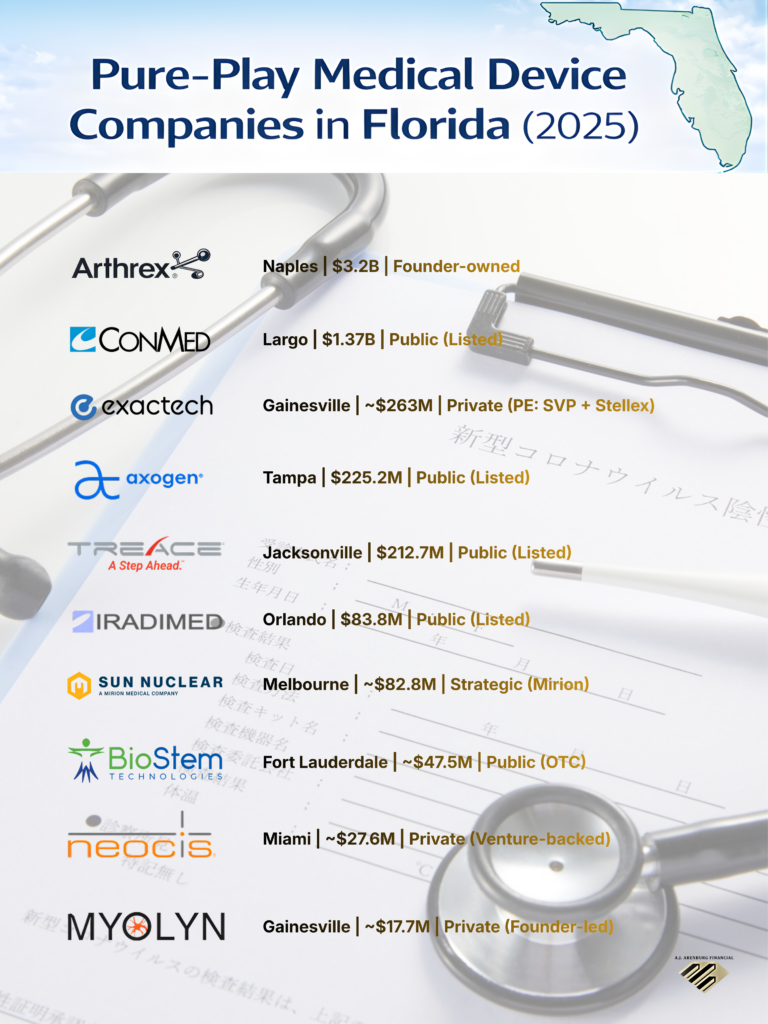
The consistency across these businesses highlights an important theme: high-quality medtech companies with strong clinical adoption tend to outperform even in tighter capital environments.
Private Equity Re-Engagement
Private equity is also beginning to re-engage in the space.
Healthcare remains a priority sector for many firms due to:
- Recurring or repeat procedure-driven revenue
- Strong margins and defensibility
- Scalable platforms with add-on acquisition potential
Recent activity reflects a continued focus on platform investments and consolidation strategies, particularly in segments with strong clinical adoption and fragmented competition.
For example:
- Exactech’s acquisition by TPG underscores continued interest in scaling established platforms
- Broader activity from firms like Blackstone and Warburg Pincus signals sustained confidence in healthcare as a long-term investment theme
Florida as a Buy-and-Build Hub for MedTech
Beyond individual platform investments, private equity activity in Florida is increasingly centered around buy-and-build strategies.
A few dynamics driving that:
- Fragmented sub-sectors (specialty surgical, orthopedics, outpatient devices, regenerative)
- A large number of founder-owned businesses
- Strong pipeline of add-on acquisitions under $25M EBITDA
Florida, in particular, offers a density of targets + favorable operating environment (tax, labor, population growth), making it ideal for platform expansion.
Active PE Platforms in MedTech
Several private equity firms already have active platforms and are expected to remain aggressive as the market improves:
- TPG – Exactech (orthopedics platform)
- Warburg Pincus – multiple healthcare and device-related investments
- Blackstone – broad healthcare exposure, including medtech-adjacent assets
- KKR – historically active in healthcare technology and services, with device exposure
- GTCR / Welsh Carson / Thomas H. Lee – active in healthcare platforms with device integration strategies
These firms are typically looking for:
- $2M–$25M EBITDA companies
- Strong clinical niches (orthopedics, surgical tools, neuro, etc.)
- Opportunities to build through add-ons
Florida-Based & Southeast-Focused Capital
There’s also a growing base of capital in or around Florida that tends to be more aggressive in the lower-middle market:
- H.I.G. Capital (Miami)
→ Very active in healthcare; known for platform + aggressive add-on strategies - Trivest Partners (Miami)
→ Founder-friendly, lower middle market focus, often a fit for founder-led device or services businesses - Sun Capital Partners (Boca Raton)
→ Operationally focused, tends to look at carve-outs and complex situations - GreyLion / Hidden Harbor (Southeast focus)
→ Targeting industrials + healthcare adjacencies (including device supply chain)
👉 These firms are especially relevant for:
- Founder-owned med device companies
- Businesses are not yet “institutionally ready.”
- Situations requiring operational build-out before exit
Where PE is Actually Leaning in MedTech
Instead of a broad “med device,” capital is concentrating in specific pockets:
- Orthopedics & surgical tools (Florida is strong here, Arthrex, Exactech, Treace)
- Neuro/nerve repair (Axogen-type category)
- Regenerative / biologics-adjacent devices
- Outpatient / ambulatory procedure-enabling devices
- Device + software integration (AI, imaging, diagnostics)
This matters because buyers aren’t valuing “medtech” generically; they’re valuing clinical adoption + reimbursement durability + scalability.
What This Signals
The medical device industry in the Florida market has remained resilient despite recent macro pressures. The more interesting shift isn’t just that PE is “coming back.”
It’s that:
- Platforms are already in place
- Capital is being deployed more selectively
- Buyers are looking for add-ons and scalable niches, not just large headline deals
Florida sits right in the middle of that.
What This Means Going Forward
The combination of returning capital, advancing technology, and strong regional ecosystems—particularly in markets like Florida- suggests that medtech may be entering the early stages of its next growth cycle.
Conditions are still measured, but directionally, the shift is becoming more constructive:
- Deal flow is improving, with a noticeable pickup in platform and add-on activity
- Capital is becoming more available, especially for disciplined buy-and-build strategies
- Innovation is accelerating timelines, particularly with AI and software-enabled devices
- Private equity is actively deploying into fragmented niches, not just large platforms
Importantly, this isn’t just a rebound; it’s a more targeted phase of the cycle.
Buyers are no longer broadly chasing “medtech.” They’re focusing on:
- Scalable platforms with clear clinical adoption
- Add-on acquisitions in fragmented subsectors
- Founder-owned businesses that can be institutionalized and grown
In markets like Florida, where there is a high concentration of lower-middle-market device companies, this dynamic is even more pronounced. Many businesses are not only acquisition targets, but potential add-ons within existing PE-backed platforms.
For business owners, this creates a window, not a peak.
The companies that will see the strongest outcomes are those that:
- Maintain clean, defensible financials that can withstand diligence
- Demonstrate consistent, procedure-driven, or recurring demand
- Operate within niches that are attractive for consolidation
- Have the infrastructure (or potential) to scale under institutional ownership
The opportunity isn’t just in timing the market, it’s in being positioned for how buyers are actually deploying capital today.
About A.J. Arenburg Financial
A.J. Arenburg Financial is a boutique investment banking and advisory firm focused on lower middle market businesses. We work directly with owners to prepare, position, and execute transactions in a way that holds up under real buyer and lender scrutiny.
Our clients are typically generating $10M to $250M in revenue and $2M to $25M in EBITDA across several sectors of focus, including industrials, construction, business services, and select healthcare and technology sectors. Many are founder-led or family-owned businesses navigating growth, liquidity, or succession decisions.
We advise on sell-side M&A, business valuations, financial due diligence, and capital strategy. This includes Quality of Earnings analysis, normalization of EBITDA, working capital assessment, and building financials that align with how buyers and lenders actually evaluate risk.
Beyond transactions, we support owners ahead of a sale through exit planning and fractional CFO work. That means cleaning up financials, identifying gaps, and positioning the business properly before going to market.
Our approach is hands-on and execution focused. We are not a volume shop. Every engagement is built around presenting a credible, defensible story to buyers and driving a process that gets done.
Sources & Further Reading
- Bain & Company – Global Healthcare Private Equity Report
- Company filings and investor materials (CONMED, Axogen, Treace Medical Concepts)
- Industry coverage from MedTech Dive and PitchBook