
The Florida logistics industry is no longer just a supporting function for the broader U.S. economy. It is becoming a central hub for distribution, trade, and supply chain activity across the Southeast and Latin America.
What’s driving this shift is not just geography, but measurable growth across population, infrastructure, and freight volumes.
Market Growth and Demand Drivers
Florida’s population reached approximately 23.46 million in 2025, continuing its steady upward trend. While headlines often cite daily migration figures, the more important takeaway is consistent year-over-year growth, which directly increases demand for housing, goods, and distribution infrastructure.
At a statewide level, logistics is already a major economic driver. Florida’s seaports support nearly 1.2 million jobs and generate more than $195 billion in economic value, representing roughly 12% of the state’s GDP.
Industry estimates further reinforce this trajectory. According to Mordor Intelligence, the Florida freight and logistics market is projected to grow from approximately $78 billion in 2025 to $97 billion by 2030, reflecting steady expansion across transportation, warehousing, and fulfillment.
Port Activity and Infrastructure Expansion (2025–2026)
The strongest evidence of growth is occurring at the operating level across Florida’s major ports.
Jacksonville (JAXPORT) handled approximately 1.39 million TEUs in fiscal 2025, a 4% increase over the prior year. The port also surpassed 10 million tons of cargo and continues to benefit from major infrastructure investments, including the modernization of Blount Island and expanded vehicle processing capacity.
PortMiami processed roughly 1.12 million TEUs in fiscal 2025, marking its 11th consecutive year exceeding 1 million TEUs. Public projections indicate continued growth to approximately 1.18 million TEUs in fiscal 2026, reflecting sustained import and export demand.
Port Everglades recorded a container volume record of approximately 1.17 million TEUs in fiscal 2025, while supporting more than $28 billion in annual economic activity and over 200,000 jobs.
On Florida’s west coast, Port Tampa Bay has significantly expanded its container operations, growing from approximately 30,000 units seven years ago to nearly 350,000, supported by new international services and terminal expansion.
Beyond port activity, the state is also taking a more coordinated approach to logistics development. In 2025, Florida established an Intermodal Logistics Center Working Group to support long-term planning and integration of freight infrastructure across the state.
Major Florida Logistics Industry Companies Operating in Florida
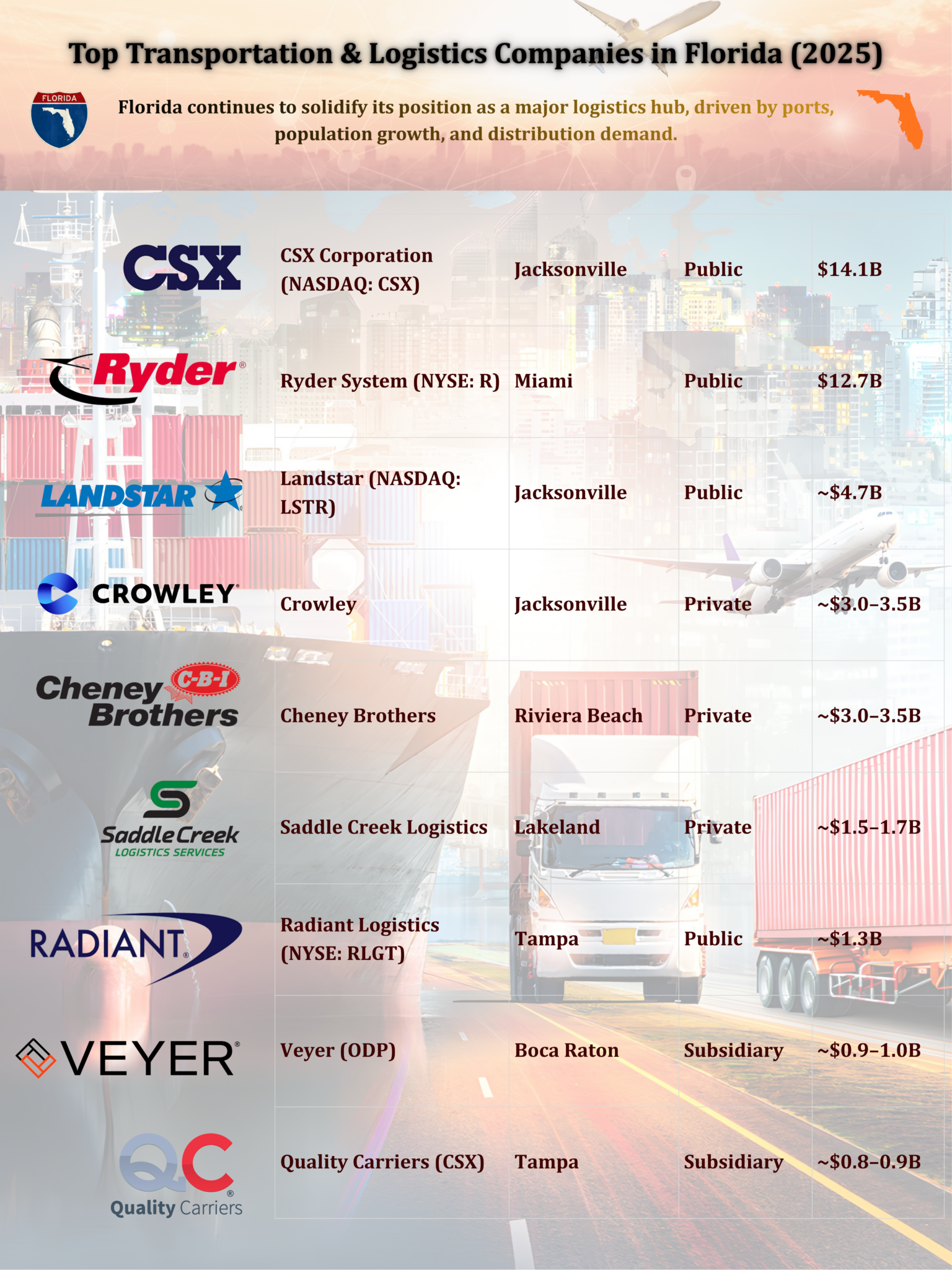
The scale of Florida’s logistics ecosystem is reflected in the companies operating within it:
- CSX Corporation — Freight rail infrastructure across the eastern United States
- Ryder System, Inc. — Fleet management and end-to-end supply chain solutions
- Landstar System, Inc. — Asset-light logistics and freight brokerage
- Crowley — Maritime, energy, and international logistics
- Saddle Creek Logistics Services — Warehousing, fulfillment, and distribution
- Radiant Logistics, Inc. — Freight forwarding and brokerage
Strategic activity is also shaping the industry. For example, CSX’s acquisition of Quality Carriers in 2021 expanded its presence in bulk chemical transportation, reflecting broader consolidation trends within logistics and transportation.
What This Means for Business Owners
For business owners, particularly in distribution, manufacturing, and service industries tied to supply chains, these trends have direct implications.
Buyers and lenders are increasingly focused on:
- Operational scalability and logistics efficiency
- Customer concentration and distribution channels
- Margin stability tied to freight and input costs
- Access to infrastructure and geographic positioning
Companies that demonstrate clean financials, consistent demand, and operational resilience are more likely to attract interest from both strategic buyers and private equity investors.
Where the Industry Is Going
Florida is transitioning from a regional transit point into a long-term logistics and trade hub.
The combination of sustained population growth, measurable increases in port throughput, and coordinated infrastructure investment suggests continued expansion across the sector.
Looking forward, the industry is likely to see:
- Increased consolidation among mid-sized operators
- Greater private equity activity in logistics and distribution
- Continued investment in automation, fulfillment, and last-mile capabilities
For business owners, the opportunity is not just participating in this growth, but being positioned correctly when it matters most.
Final Thought
The data coming out of 2025 and early 2026 points to a clear trend: Florida’s logistics sector is scaling in both size and strategic importance.
For companies operating within or adjacent to this ecosystem, understanding how buyers, lenders, and investors evaluate logistics exposure is becoming increasingly important.
About A.J. Arenburg Financial
A.J. Arenburg Financial is a boutique investment banking and advisory firm focused on lower middle market businesses. We work directly with owners to prepare, position, and execute transactions in a way that holds up under real buyer and lender scrutiny.
Our clients are typically generating $10M to $250M in revenue and $2M to $25M in EBITDA across several sectors of focus, including industrials, construction, business services, and select healthcare and technology sectors. Many are founder-led or family-owned businesses navigating growth, liquidity, or succession decisions.
We advise on sell-side M&A, business valuations, financial due diligence, and capital strategy. This includes Quality of Earnings analysis, normalization of EBITDA, working capital assessment, and building financials that align with how buyers and lenders actually evaluate risk.
Beyond transactions, we support owners ahead of a sale through exit planning and fractional CFO work. That means cleaning up financials, identifying gaps, and positioning the business properly before going to market.
Our approach is hands-on and execution focused. We are not a volume shop. Every engagement is built around presenting a credible, defensible story to buyers and driving a process that gets done.
Sources
U.S. Census Bureau — Florida Population (2025)
https://www.census.gov/quickfacts/fact/table/FL/PST045224
Florida Department of Transportation — Statewide Seaport Economic Impact Report (2026)
https://fdotwww.blob.core.windows.net/sitefinity/docs/default-source/seaport/pdfs/eia_statewide_report_jan_25_final.pdf
Mordor Intelligence — Florida Freight & Logistics Market Report
https://www.mordorintelligence.com/industry-reports/florida-freight-and-logistics-market
JAXPORT FY2025 Annual Report
https://www.jaxport.com/wp-content/uploads/2026/03/FY25-Annual-Report.pdf
PortMiami Cargo & Budget Reports (Miami-Dade County)
https://www.miamidade.gov/global/portmiami/home.page
Port Everglades Cargo & Economic Impact Data
https://www.porteverglades.net/cargo/
Florida Ports Council — Board Materials (2025)
https://flaports.org/wp-content/uploads/FPC-Board-Book-8.26.25.pdf
Florida Statutes — Intermodal Logistics Center Working Group (2025)
https://www.leg.state.fl.us/Statutes/index.cfm?App_mode=Display_Statute&URL=0300-0399/0311/Sections/0311.101.html