

Private equity has aggressively targeted the U.S. HVAC (heating, ventilation, and air conditioning) sector over the past three years. From 2024 through early 2026, the industry has experienced record deal volume, accelerated platform formation, and a surge in add-on acquisitions, positioning HVAC as one of the most actively consolidated sectors in the lower middle market.
This trend is driven by a combination of recurring revenue, market fragmentation, regulatory tailwinds, and operational scalability, making HVAC businesses highly attractive to institutional capital.
HVAC Private Equity Consolidation Trends
HVAC private equity consolidation has accelerated significantly across the United States, as investors continue to pursue fragmented service-based industries with recurring revenue and strong cash flow characteristics.
According to PitchBook, HVAC private equity consolidation activity reached record levels in recent years, highlighting the growing interest from institutional buyers in scalable HVAC platforms. You can review their market insights here.
This surge in HVAC private equity consolidation is being driven by a combination of platform acquisitions and aggressive add-on strategies, where firms acquire smaller regional HVAC businesses to build larger, more valuable enterprises. As HVAC private equity consolidation continues, more founder-owned companies are becoming targets for recapitalization or full sale processes.
Record Deal Activity and Acceleration
The pace of private equity investment in HVAC has increased significantly:
- In 2024, HVAC deal count reached 55 transactions, representing a 72% increase year-over-year and the highest level recorded in recent datasets.
- By mid-2025, 77 HVAC services transactions had already closed.
- By the end of 2025, total HVAC-related deals reached approximately 149 transactions, reflecting continued momentum despite broader M&A slowdown.
This level of activity places HVAC among the most active sub-sectors within industrial and business services M&A.
The Platform + Add-On Strategy
The dominant investment model across private equity firms is the platform and add-on acquisition strategy. Firms acquire a platform company, typically in the 5 million to 25 million EBITDA range, then execute multiple add-on acquisitions of smaller regional HVAC operators. Over time, they scale operations, expand geographic reach, and improve margins before exiting at a higher multiple through recapitalization or sale.
Notable Private Equity Platforms
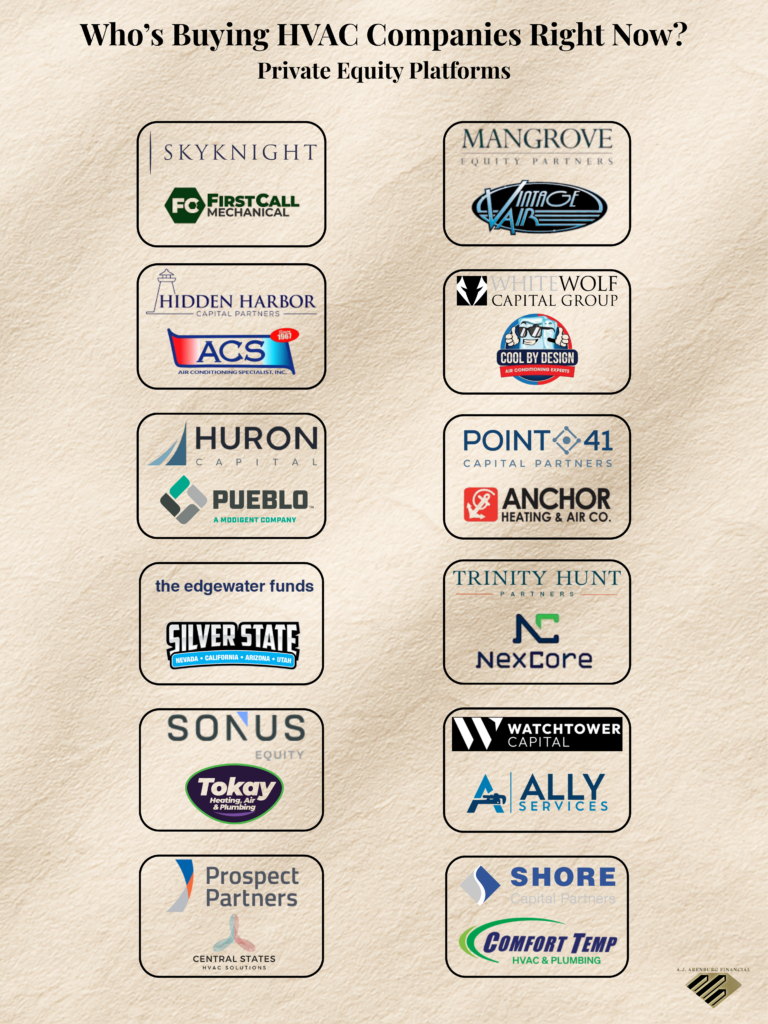
Several private equity firms have established large HVAC platforms through aggressive acquisition strategies. Examples include White Wolf Capital Group, which has built a large roll-up with multiple add-on acquisitions including Cooling By Design, and Point 41 Capital Partners, whose platform includes Interstate AC and Anchor Heating and Air. Watchtower Capital has developed a highly concentrated HVAC portfolio through Ally Services Group and multiple regional operators, while Hidden Harbor Capital Partners built Air Conditioning Specialist through numerous Southeast acquisitions. Huron Capital expanded Pueblo Mechanical and Controls through more than a dozen acquisitions, and SkyKnight Capital formed FirstCall Mechanical as a multi-entity platform from inception.
Why HVAC Is So Attractive to Private Equity
HVAC companies exhibit several characteristics that align with private equity investment strategies. These include
• Recurring revenue generated through maintenance contracts, repair services, and replacement cycles, creating predictable cash flow
• A highly fragmented market dominated by small, owner-operated businesses, providing a large pipeline of acquisition targets
• Labor constraints and supply complexity that create pricing power and support margin expansion
• Regulatory tailwinds, particularly refrigerant changes beginning in 2025, which are increasing replacement demand and favoring scaled operators
• Multiple expansion opportunities where smaller businesses trade at lower EBITDA multiples while scaled platforms command significantly higher valuations
Add-On Acquisitions Dominate the Market
Across private equity, add-on acquisitions now represent a significant portion of total deal activity. HVAC has seen a particularly high frequency of tuck-in acquisitions, with many platforms completing between 5 and 20 acquisitions over a relatively short period. This reflects a shift toward building scaled enterprises through consolidation rather than relying solely on organic growth.
Large-Scale Validation from the Market
Recent transactions further validate the attractiveness of the sector. Sila Services reportedly reached a valuation of approximately 1.5 billion dollars, while ARS Rescue Rooter explored a sale exceeding 3.5 billion dollars. Madison Air completed a 2.23 billion dollar IPO in 2026, highlighting institutional demand tied to HVAC and cooling infrastructure.
Outlook
The HVAC sector is expected to remain highly active. Continued fragmentation ensures a deep pipeline of acquisition targets, while private equity firms remain well-capitalized and focused on deployment. Regulatory changes, infrastructure investment, and increasing demand for cooling tied to data centers and energy systems are expected to support long-term growth.
From 2024 through 2026, the HVAC industry has emerged as one of the most actively consolidated sectors in private equity. The combination of recurring revenue, fragmentation, regulatory drivers, and scalable operations has created an ideal environment for platform-based investment strategies. Private equity firms continue to execute this model at scale, and the pace of acquisitions suggests that the consolidation cycle is still in its early to middle stages.
About A.J. Arenburg Financial
A.J. Arenburg Financial is a boutique investment banking and advisory firm focused on lower middle market businesses. We work directly with owners to prepare, position, and execute transactions in a way that holds up under real buyer and lender scrutiny.
Our clients are typically generating $10M to $250M in revenue and $2M to $25M in EBITDA across several sectors of focus, including industrials, construction, business services, and select healthcare and technology sectors. Many are founder-led or family-owned businesses navigating growth, liquidity, or succession decisions.
We advise on sell-side M&A, business valuations, financial due diligence, and capital strategy. This includes Quality of Earnings analysis, normalization of EBITDA, working capital assessment, and building financials that align with how buyers and lenders actually evaluate risk.
Beyond transactions, we support owners ahead of a sale through exit planning and fractional CFO work. That means cleaning up financials, identifying gaps, and positioning the business properly before going to market.
Our approach is hands-on and execution focused. We are not a volume shop. Every engagement is built around presenting a credible, defensible story to buyers and driving a process that gets done.
Sources
- Pitchbook – https://pitchbook.com/news/reports/q2-2025-pitchbook-analyst-note-clearing-the-air-on-hvac
Capstone Partners – https://www.capstonepartners.com/insights/hvac-services-industry-update
KPMG – https://kpmg.com/us/en/articles/2025/q3-2025-pulse-private-equity-global-investment-trends.html
Reuters – https://www.reuters.com/markets/deals/morgan-stanley-sell-hvac-firm-sila-goldman-sachs-2024-11-11/
U.S. Environmental Protection Agency – https://www.epa.gov/climate-hfcs-reduction/technology-transitions-rule - S&P Global Market Intelligence – https://www.spglobal.com/market-intelligence/en/news-insights/articles/2025/10/hvac-deals-demonstrate-private-equity-s-appetite-for-add-ons