
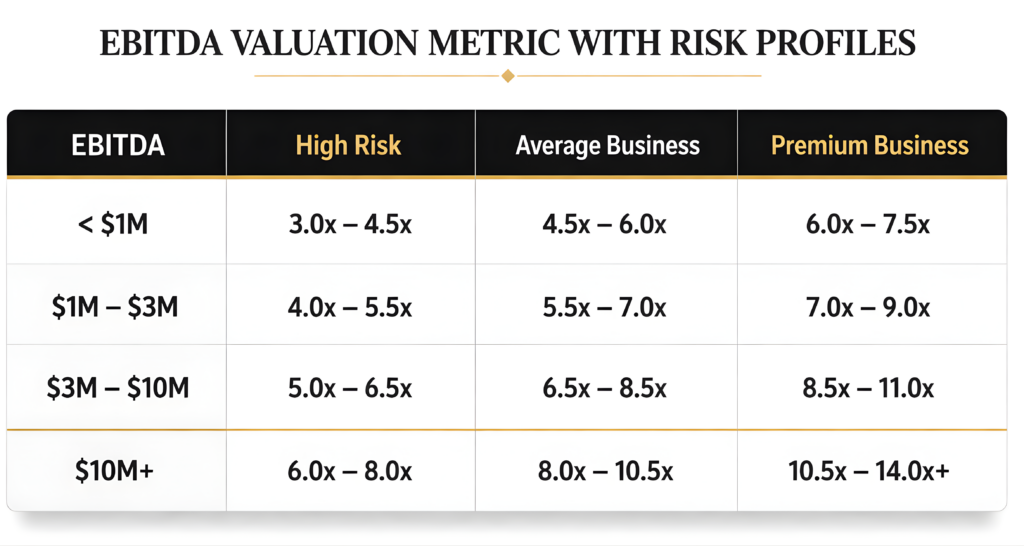
Business valuation EBITDA is one of the most widely used methods to estimate what your company is worth in today’s market. Most business owners don’t have a valuation problem.
They have a clarity problem.
They hear numbers thrown around—5x, 8x, 10x—but no one explains why those numbers change, or more importantly:
Why two businesses with the same EBITDA can sell for completely different values.
In today’s market, that gap is wider than it’s been in years.
Start With the Only Formula That Matters
At its core, valuation in the lower middle market still comes down to:
Business Value = EBITDA × Multiple
But that simplicity is misleading.
Because while EBITDA is a number…
👉 The multiple is a reflection of risk, quality, and buyer demand
And that’s where most of the variation and opportunity comes from.
What the Data Actually Shows (2024–2025 Market)
Buyers rely heavily on business valuation EBITDA benchmarks when comparing opportunities across industries. Recent transaction data across platforms like GF Data, Axial, and PitchBook shows a few clear patterns:
- Most lower middle market deals close between 6.0x – 8.5x EBITDA
- Premium, well-positioned businesses can achieve 9.0x – 12.0x+
- Higher-risk or less prepared companies fall into the 4.0x – 6.0x range
This isn’t theoretical—it reflects how buyers are actively pricing deals today.
And importantly:
The spread between low and high outcomes is often 3–5 turns of EBITDA
For a $5M EBITDA business, that’s a $15M–$25M difference in value.
A Practical Valuation Framework You Can Use
Instead of guessing, you can use a simple framework based on:
- EBITDA size
- Risk profile
- Business quality
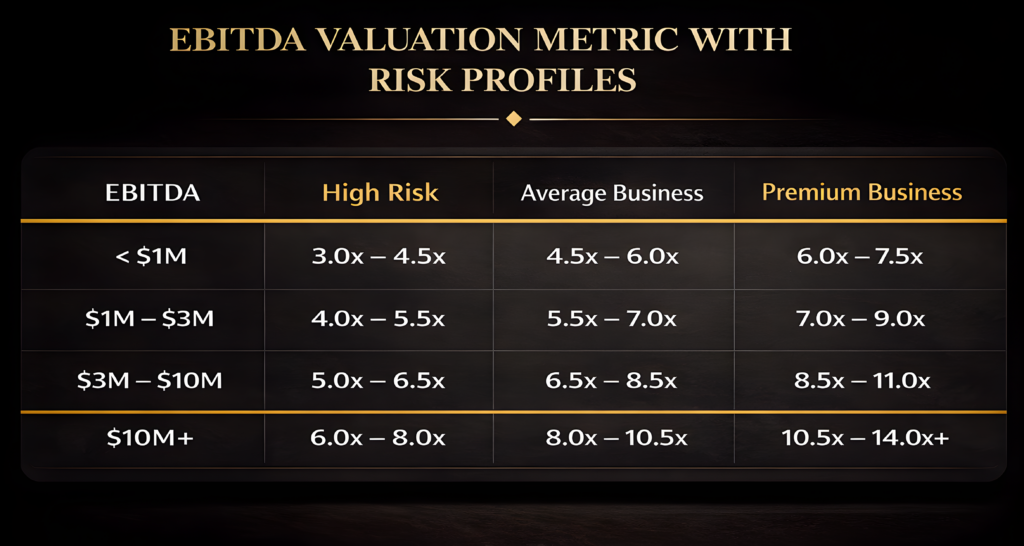
Private market data platforms like PitchBook continue to show strong activity in the lower middle market.
This matrix reflects how transactions are typically priced across the lower middle market.
It’s not a precise valuation, but it’s a highly effective starting point.
How Business Valuation EBITDA Multiples Actually Work
Most owners look at a chart like this and immediately ask:
“Which multiple am I?”
That’s the wrong approach.
The right way to use it:
Step 1: Identify Your EBITDA Range
Use adjusted EBITDA, not tax return income.
- Add back:
- Owner compensation above market
- One-time expenses
- Non-operating costs
Step 2: Assess Your Risk Profile Honestly
This is where valuation is determined.
Ask yourself:
- Is revenue recurring or project-based?
- Is there customer concentration?
- Can the business run without you?
- Are financials clean and defensible?
Step 3: Apply a Realistic Range (Not a Single Number)
Example:
- EBITDA: $4M
- Profile: Slight concentration, otherwise stable
👉 Falls in:
- Range: $3M–$10M EBITDA
- Profile: Average
Estimated multiple:
6.5x – 8.5x
Estimated valuation:
$26M – $34M
Why Multiples Vary More Than Most People Think
Multiples are not arbitrary.
They are a pricing mechanism for risk and future cash flow.
Two companies with identical EBITDA can have dramatically different outcomes because:
- One is predictable
- One is uncertain
And buyers pay a premium for predictability.
The Real Drivers Behind Your Multiple
While industry plays a role, valuation is primarily driven by business fundamentals.
Key drivers include:
Revenue Quality
- Recurring vs project-based
- Contracted backlog
- Customer retention
Customer Concentration
Diversified base → premium
30% from one client → significant discount
Management & Structure
- Owner-dependent → lower multiple
- Scalable team → higher multiple
Financial Transparency
- Clean books → confidence
- Messy records → pricing uncertainty
Growth Profile
- Flat → baseline multiple
- 10–20% growth → premium expansion
How Buyers Actually Adjust Multiples
This is where most owners underestimate how structured the process is. Recent lower middle market data shows most transactions fall within a 6.0x–8.5x range, based on aggregated deal data from GF Data and similar sources.
Buyers don’t “guess” a multiple; they adjust it based on risk. Most buyers rely on business valuation EBITDA multiples to benchmark value before adjusting for risk. Buyers rely heavily on business valuation EBITDA benchmarks when comparing opportunities across industries.
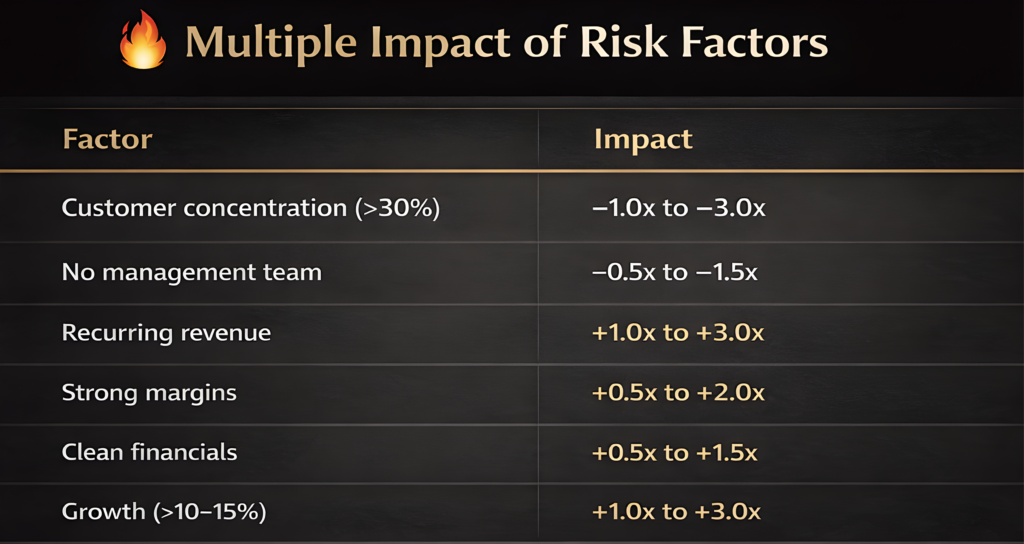
This reflects typical adjustments seen in real transactions.
For example:
- Customer concentration → can reduce value by 1.0x – 3.0x EBITDA
- Recurring revenue → can increase value by 1.0x – 3.0x
- Strong growth → additional multiple expansion
These adjustments stack.
Which is why two businesses in the same industry can end up with completely different valuations.
Real-World Example: Same EBITDA, Different Outcome
Let’s compare two businesses:
Company A (Higher Risk)
- $5M EBITDA
- 40% revenue from one client
- No management team
- Project-based work
👉 Likely valuation:
- 5.5x – 6.5x
- ~$27.5M – $32.5M
Company B (Premium Profile)
- $5M EBITDA
- Recurring contracts
- Diversified customers
- Strong margins + growth
👉 Likely valuation:
- 9.0x – 11.0x+
- ~$45M – $55M+
Industry Still Matters, But Less Than You Think
While industry matters, business valuation EBITDA ranges are ultimately adjusted based on quality and risk.
Current ranges across sectors:
- Industrial / Construction → 4x – 8x
- Business Services → 5x – 9x
- Healthcare → 6x – 11x
- Technology (SaaS) → 8x – 15x+
But industry is just the starting point.
A premium business in a “lower multiple” industry can outperform an average business in a “higher multiple” sector.
Where Most Owners Leave Money on the Table
Common mistakes:
- Overstating EBITDA with weak addbacks
- Ignoring customer concentration risk
- Waiting too long to prepare
- Going to market without a structured process
- Assuming buyers will “see the potential.”
They won’t.
Buyers price what is proven—not what is possible.
The Real Opportunity: Pre-Sale Positioning
The biggest valuation increases don’t happen during negotiations. Improving your business valuation EBITDA multiple often comes down to preparation and positioning.
They happen before the business goes to market.
Owners who focus on:
- Cleaning financials
- Reducing risk exposure
- Building management depth
- Improving margins
…consistently move up the valuation range.
Valuation isn’t simply about applying a multiple to your EBITDA—it’s about understanding where your business stands today within the market and what factors are influencing that position. More importantly, it’s about identifying what needs to change to move your business into a higher valuation range. The real value isn’t just in the number itself, but in the improvements and positioning that can meaningfully increase what a buyer is willing to pay.
If you’re in the $2M–$10M EBITDA range, the difference between an average and premium valuation can be substantial.
A.J. Arenburg Financial works with business owners to:
- Benchmark valuation ranges
- Identify value gaps
- Prepare for a structured sale process
About A.J. Arenburg Financial
A.J. Arenburg Financial is a boutique investment banking and advisory firm focused on lower middle market businesses. We work directly with owners to prepare, position, and execute transactions in a way that holds up under real buyer and lender scrutiny.
Our clients are typically generating $10M to $250M in revenue and $2M to $25M in EBITDA across several sectors of focus, including industrials, construction, business services, and select healthcare and technology sectors. Many are founder-led or family-owned businesses navigating growth, liquidity, or succession decisions.
We advise on sell-side M&A, business valuations, financial due diligence, and capital strategy. This includes Quality of Earnings analysis, normalization of EBITDA, working capital assessment, and building financials that align with how buyers and lenders actually evaluate risk.
Beyond transactions, we support owners ahead of a sale through exit planning and fractional CFO work. That means cleaning up financials, identifying gaps, and positioning the business properly before going to market.
Our approach is hands-on and execution focused. We are not a volume shop. Every engagement is built around presenting a credible, defensible story to buyers and driving a process that gets done.