

A HYPOTHETICAL ANALYSIS BASED ON HOW FACTORS GENERALLY AFFECT THE MARKETS
The stock market showed remarkable resilience in 2023 despite the Federal Reserve’s interest rate hikes and the unique elements of fiscal policy that were implemented in response to a period of economic slowdown during the global pandemic. However, the fiscal policies of the Biden administration, while providing the capital necessary to stimulate businesses, also led to a surge in the cost of goods and financial margin deterioration, which are showing signs of recovery but are not yet back to pre-pandemic levels. Along with disruptions in supply chains, this has caused an increase in commodity prices, such as fuel, resulting in significantly lower gross and net profit margins for many business owners.
The lower market consists mostly of small micro-cap businesses in the United States, whose balance sheets are intangible heavy. This means that their enterprise value is mostly derived from Goodwill, which is the excess enterprise value that a business receives in a successful business sale. The intrinsic value of an enterprise is typically derived from the tangle asset derived cashflow using the common DCF or discounted cash flow model. Public markets use interest rates and equity values to anticipate future events.
Currently, the market is anticipating a pause and several rate cuts in 2024. However, it is our opinion that this is not going to happen and that equity markets are overvaluing many of these entities. This recent excitement around rate cuts and good CPI, PPI, and jobs reports have led to a surge in S&P100 highs, which will get a major haircut if the assumed cuts do not happen.
CPI and PPI readings this week ~ Scenarios and Effects
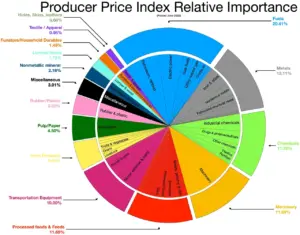
CPI is higher than expected (HOT)
Inflation concerns may spike, leading to market volatility. Equities could potentially decline due to fears that consumer spending might decrease, and the Federal Reserve could respond with aggressive interest rate hikes. Bond yields might rise as bond prices drop, reflecting the anticipation of higher rates and inflationary pressures.
CPI is in line with expectations
The market might exhibit less volatility, maintaining current trends or showing mild positive reactions. Equities could hold steady or increase slightly as in-line CPI reduces uncertainty, and bonds might see less movement in yields, indicating market stability.
PPI IS HIGHER THAN EXPECTED (HOT)
This could signal increased production costs, potentially squeezing corporate profits and leading to higher prices for consumers. Equities, especially in consumer-sensitive sectors, might drop in anticipation of decreased spending. Bonds could react similarly to a hot CPI, with yields rising.
PPI IS IN LINE WITH EXPECTATIONS
It may have little to no dramatic effect on equities and could lead to a neutral or positive market response. Bonds might not see significant movement as in-line PPI suggests stable economic conditions without immediate inflationary threats.
KEEPING AN EYE ON THE FINANCIAL MARKETS & INTEREST RATES
In 2022 and 2023, financial sectors offered key insights into M&A market lending, yet navigating the lower market proved challenging for industry professionals. Presently, the sector is undergoing significant innovation, transitioning away from traditional financial products. Interest rates display marked volatility, casting doubt on the timing and extent of Federal Reserve rate reductions. Current market expectations suggest 4-5 rate cuts this year; however, our analysis projects a likelihood of just 1-2 cuts.
With critical metrics like CPI, PPI, and impending bank earnings, market trends have been laterally static. Our firm has strategically positioned shorts in financial markets via derivatives, anticipating a downturn driven by upcoming earnings and CPI reports. This approach reflects our stance that a market correction is warranted, especially as financial entities such as JP Morgan Chase reach peak valuations. While banks benefit from interest income, elevated rates may curtail their lending volume. Additionally, banks extending credit face potential earnings pressure as default indications emerge in financial disclosures. We foresee market instability surpassing the widely discussed “Soft Landing” scenario, given the inflated valuations and perceived imprudent investments by retail investors in companies like NVDA and TSLA, overlooking inherent risks. This prevailing uncertainty impacts the lower and middle markets, with pricing disputes significantly influencing transaction default rates. Addressing these disputes necessitates innovative transaction strategies and critical financial analysis.
The chart displays the target rate probabilities for the Federal Reserve (Fed) meeting on January 31, 2024 (Q1)
The current market consensus is firmly aligned with expectations of a dovish pivot by the Federal Reserve, with a unanimous (100%) probability of an interest rate decrease by December 18, 2024. The prevailing sentiment is best encapsulated by the 37.6% likelihood assigned to the target rate easing into the 375-400 bps bracket, suggesting a moderate easing is the most anticipated outcome. Additionally, a 27.5% probability is attached to the target rate settling between 400-425 bps, indicating that while expectations are rife for easing, opinions diverge on the scale.
The market also assigns a substantial 21.1% chance that the rates could be adjusted more aggressively, falling within the 350-375 bps range. Conversely, expectations taper off for deeper cuts, with only 10.2% foreseeing a target rate within the 425-450 bps range and a mere 2% considering a reduction to the 450-475 bps range. The possibility of rates dipping to between 325-350 bps or 475-500 bps is seen as marginal at best, with probabilities at 1.2% and 0.2%, respectively.
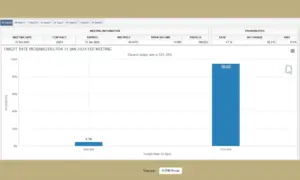
The data illustrates a clear market inclination towards monetary easing, suggesting that investors are preparing for a softer economic policy stance from the Fed by Q2 2024. This could be interpreted as the market factoring in weaker economic conditions or an achieved inflation target that permits a loosening of interest rates.
The Market’s expectations for the Fed’s interest rate decision:
- There is a 95.3% probability that the FED will maintain the current target rate at 525-550 basis points (bps), indicating strong market consensus for no change in the policy rate.
- Conversely, there is a 4.7% chance of a rate cut, bringing the target rate down to the 500-525 bps range.
- There is a 0.0% probability of a rate hike, suggesting no market expectation for tightening monetary policy at this meeting.
The market data related to the ZQK4 futures contract, expiring on May 31, 2024, with a mid-price of 95.0675, demonstrates a significant engagement of traders speculating on the Federal Reserve’s rate decisions, as reflected by the high prior volume of 37,644 and open interest of 103,963. This active trading correlates with the anticipation of a potential rate decrease, evidenced by a mid-price of 95.9850 and the lower volume and open interest figures of 779 and 4,861, respectively, for another contract. The expectations suggest a market consensus for a moderate rate reduction from the current 525-550 basis points, implying that participants are hedging for easing monetary policy but without foreseeing radical departures from established rates.
The prevailing sentiment conveys a conviction in the economy’s resilience or the Federal Reserve’s success in hitting its inflation and employment targets, with minimal prospects for imminent rate cuts. This cautious stance aligns with recent economic indicators that suggest lessened inflationary concerns and adequate growth, diminishing the urgency for further rate reductions to stimulate the economy.
The chart below illustrates the target rate probabilities for the Federal Open Market Committee (FOMC) meeting on June 12, 2024 (Q2)
The data illustrates a clear market inclination towards monetary easing, suggesting that investors are preparing for a softer economic policy stance from the Fed by Q2 2024. This could be interpreted as the market factoring in weaker economic conditions or an achieved inflation target that permits a loosening of interest rates.
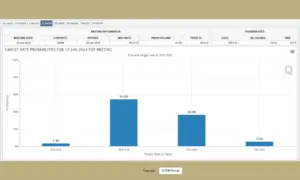
The chart illustrates the target rate probabilities for the Federal Open Market Committee (FOMC) meeting on June 12, 2024 | A.J. Arenburg Financial Equity Research Division
The Market’s expectations for the Fed’s interest rate decision:
- There is a unanimous expectation (100%) of an easing of interest rates by the Fed.
- The most likely target rate, with a 54.5% probability, is within the 450-475 basis points (bps) range.
- The next probable target rate, at 36.6%, is seen in the 475-500 bps range.
- A smaller segment of the market (5.5%) anticipates the target rate might only be reduced slightly to the 500-525 bps range.
- There’s a very marginal expectation (3.3%) of a more significant rate cut to the 425-450 bps range.
- No probability is assigned for the rates to remain unchanged or for a rate hike, indicating the market is not expecting any tightening of monetary policy at this meeting.
The market data coalesce to vivid anticipation of monetary policy easing by the Federal Reserve, with the mid-price oscillating notably at 95.6175 and 95.2175, respectively. These figures, juxtaposed with a prior volume of 2,731 and a subsequent volume of 4,335, alongside a notable increase in open interest from 19,852 to 41,519 contracts, underscore a robust consensus for an impending rate reduction. This consensus is not merely a speculative whim but a stratagem by market participants to buffer against varying economic outcomes that may prompt the Fed’s hand. The diverse probabilities assigned to different target rate ranges, veering predominantly towards rate cuts, reflect a strategic market hedge. They are indicative of the collective market’s predictive measures considering potential economic headwinds, including subdued inflation or other fiscal challenges that could influence the Federal Reserve’s decision-making in the latter half of 2024.
The chart presents the target rate probabilities for the Federal Reserve’s meeting on September 18, 2024 (Q3)
The analytical projection delineated in the chart for the Federal Reserve’s meeting slated for September 18, 2024, evinces unanimous market sentiment (100%) in favor of an interest rate reduction. The predominant forecast (41.5%) hinges on the Federal Reserve targeting the interest rate within the 400-425 basis points (bps) ambit. Not far behind in market consensus, a 40.2% likelihood is attributed to the target rate being calibrated to a 425-450 bps window.
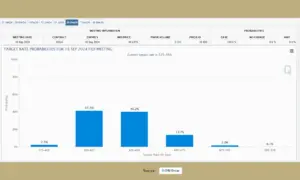
The chart presents the target rate probabilities for the Federal Reserve’s meeting on September 18, 2024 | A.J. Arenburg Financial Equity Research Division
There is, however, a more moderate conjecture (13.7%) suggesting a descent of the target rate to the 450-475 bps range. Conversely, a scant minority of market participants (2.5%) are postulating a more aggressive cut to usher the target rate into the 375-400 bps stratum. The probabilities ascribed to even more substantial rate abatements, settling the target rate between 475-500 bps and 500-525 bps, remain marginal at 2.0% and 0.1%, respectively.
Reflected by a mid-price of 95.6175 and the previous volume standing at 2,731, with an accompanying open interest of 19,852 contracts, there is palpable market anticipation for a rate diminution. This array of probabilities spanning different target rate ranges encapsulates the market’s hedging against diverse economic eventualities that may influence the Federal Reserve’s monetary policy decisions come the third quarter of 2024.
The market’s expectations for the Fed’s monetary policy decisions are as follows:
- There is a consensus (100%) that the Federal Reserve will ease interest rates.
- The highest probability (41.5%) is for the target rate to be adjusted to the 400-425 basis points (bps) range.
- A closely comparable probability (40.2%) is for the target rate to be set within the 425-450 bps range.
- There is a smaller likelihood (13.7%) of the target rate being reduced further to the 450-475 bps range.
- Very few market participants (2.5%) anticipate a more substantial rate cut that would bring the target rate down to the 375-400 bps range.
- The probabilities for the target rates of 475-500 bps and 500-525 bps are quite low at 2.0% and 0.1%, respectively.
With the mid-price standing at 95.6175 and the prior volume at 2,731, coupled with an open interest of 19,852 contracts, the data indicates strong market anticipation of a rate cut. The distribution of probabilities across various target rate ranges suggests that while there is certainty about easing, there is some dispersion regarding the extent of the rate cut, which reflects the market’s attempt to price in various potential economic scenarios that the Federal Reserve might be responding to by Q3 2024.
The chart provides the target rate probabilities for the Federal Reserve’s meeting on December 18, 2024
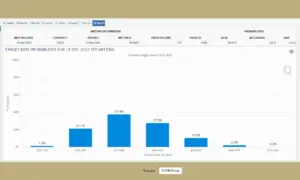
The chart provides the target rate probabilities for the Federal Reserve’s meeting on December 18, 2024 | A.J. Arenburg Financial Equity Research Division
Here’s the Market’s expectations:
- A rate easing is unanimously expected (100%) by the market.
- The most probable target rate is in the 375-400 basis points (bps) range, with a 37.6% probability.
- The next likely target rate is within the 400-425 bps range at 27.5% probability.
- A lower probability of 21.1% is associated with the target rate being set within the 350-375 bps range.
- Fewer market participants expect the rate to be in the 425-450 bps range (10.2%) or the 450-475 bps range (2.0%).
- A very small segment anticipates more aggressive cuts, with only 1.2% for the 325-350 bps range and 0.2% for the 475-500 bps range.
This distribution of probabilities signals a strong market sentiment toward further monetary policy easing. The mid-price of 95.9850, the relatively low prior volume of 779, and the open interest of 4,861 contracts suggest that while there is participation in this forecasting, the market may not be expecting large movements from the current target rate, which is set at 525-550 bps.
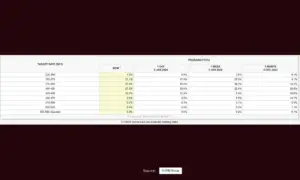
The data snip provides a comprehensive view of the market’s expectations for Federal Reserve interest rate decisions over time, showcasing the probabilities of different target rate ranges. Currently, the Fed’s target rate is within the 525-550 basis points (bps) range | A.J. Arenburg Financial Equity Research Division
Throughout the quarters of 2024, the Federal Reserve’s interest rate decision-making landscape, as predicted by market probabilities, suggests a pattern of monetary policy easing. The probability analysis indicates a stepwise decrease in the target rate range from the current 525-550 basis points (bps) to as low as 375-400 bps. This trend reflects market sentiment that the Federal Reserve may continue to lower rates in response to evolving economic conditions.
In the final quarter, the highest probability consolidates around the 375-400 bps range, signifying the most aggressive anticipation of rate cuts within the year. This quarter-by-quarter progression into lower rate territories underscores the market’s adjustment to expectations of softer monetary policy—a response likely driven by the dual objectives of fostering economic growth and keeping inflation in check.
As we close this analytical section, it is evident that while the market prepares for a dovish turn from the Fed, the nuanced probabilities across different rate ranges reveal a canvas of uncertainty. Investors and policymakers alike must navigate these predictive currents with a blend of strategic foresight and cautious optimism, ever mindful of the complex interplay between economic indicators and monetary policy decisions.
ANOTHER COMPONENT TO LOOK AT IS THE WEAKENING DOLLAR
As of 12:40 pm EST on January 10, 2024, the data provided by TD Ameritrade’s thinkorswim platform presents an insightful snapshot of the market’s currency expectations. The weakening dollar, captured in this moment of trading, signals a pivotal shift that resonates through global financial markets. Policymakers and investors alike are now equipped with crucial information, charting their course through a multifaceted economic environment where currency valuations play an instrumental role | A.J. Arenburg Financial Equity Research Division
The implications for the markets are multifaceted. A weaker dollar could boost US export competitiveness but may also increase the cost of imports, affecting inflation. For investors, this could mean recalibrating the currency risk in their portfolios, particularly in international holdings.
As we traverse into 2024, the U.S. dollar has demonstrated resilience, likely due to the markets pre-empting the Federal Reserve’s interest rate policy. The prevailing sentiment had leaned towards an expectation of a 64 basis point decrease in the Fed funds rate over a six-month horizon. However, analysts from Rabobank suggest that these projections may undergo significant adjustments, which could provide a bulwark to the dollar in the short-term spectrum of one to three months.
The Euro faces bearish forecasts, especially given the economic vulnerabilities of Germany, poised to catalyze a descent of the EUR/USD pair to an anticipated trough of 1.05 in the ensuing quarter. This projection rests on the current temper of market sentiment and the pulse of economic indicators. Yet, there’s an anticipation of a pivot in the dollar’s prospects in the second semester as prospective Fed rate cuts might stoke risk appetites, subsequently diluting the dollar’s valuation.
Today’s market snapshot reveals a discernible softening of the dollar across a swath of currencies. There is a marked downturn against traditionally stable currencies such as the Swiss Franc and Japanese Yen, signaling a pivot in investor sentiment favoring safe-haven assets over the dollar.
This downtrend is further accentuated by adverse swap rates and P/L ratios, signaling a market consensus skewed towards betting against the dollar’s vigor. Such a trend may stem from a cocktail of factors, including prognostications of a Federal Reserve tilt towards dovishness, geopolitical flux, or a recalibration of global trade dynamics.
GEOPOLITICAL RISK IS JUST AS IMPORTANT AS FISCAL POLICY

In finance, interest rates and economic data drive the equity and fixed-income or bonds markets. Most traders and investors know this, as it’s basic, just like bonds move inverse of equities, we’ve witnessed an anomaly to this in 2022 and 2023, with the bond yield inverted and short and long-term bond prices moving with volatility. Additionally, another market indicator that is important to watch in the market is the call the VIX, or the volatility index.
Recent regional instabilities have indeed compounded market volatility. As noted by the International Monetary Fund, the Middle East and Central Asia are grappling with the knock-on effects of global downturns, domestic strife, and geopolitical tensions, all of which threaten to derail economic momentum. Merrill Lynch also acknowledges that the escalation of conflict in Israel and Gaza, among other geopolitical hotspots, may have far-reaching impacts on both the economy and financial markets. Moreover, the outbreak of new conflicts in the Middle East has heightened the uncertainty already present due to monetary policy tightening and financial stability risks.
Geopolitical strife is increasingly a wild card in economic forecasts. The Middle East’s enduring conflicts, exacerbated by new warfare, add layers of unpredictability, threatening to disrupt global supply chains and inflate commodity prices, notably oil. These geopolitical rifts, coupled with Europe’s own tensions, not only fuel market instability but also pose a tangible recessionary threat. As investors navigate these choppy waters, the recalibration of risk parameters becomes paramount. Historical trends suggest that while markets are cognizant of such perils, the trajectory of economic cycles often holds greater sway in the long term, as posited by J.P. Morgan. However, with the current climate of heightened alert, the interconnectedness of geopolitical and economic domains may prove to be a decisive factor in shaping market outcomes and the risk of recession moving forward.
The foundational principles of finance posit that interest rates and economic data are pivotal in steering the equity and bond markets. Typically, bond prices tend to move inversely to equity markets, reflecting their role as a haven during equity market downturns. However, in 2022 and 2023, the financial landscape exhibited atypical patterns. The inversion of the bond yield curve, a harbinger of recession, became a focal point as yields on short-term bonds exceeded those on long-term bonds, denoting investor skepticism about future economic growth. This inversion, alongside heightened volatility across bond maturities, underscored the market’s response to unprecedented economic conditions.
REEVALUATING MARKET FUNDAMENTALS IN 2024
As we transition into 2024, it is crucial to reassess these foundational market dynamics. The previous years’ anomalies in bond and equity markets prompt a more nuanced understanding of market indicators and their interplay. The traditional inverse relationship between bonds and equities, though historically reliable, may not hold uniformly in the face of unconventional monetary policies and global economic shifts. Investors should remain vigilant, particularly in monitoring the VIX, as it reflects market volatility and investor sentiment, which can diverge from traditional economic indicators. Moving forward, a blend of caution and adaptability will be essential for navigating the financial markets, ensuring that strategy aligns with the evolving economic landscape.
The Volatility Index (VIX), often dubbed the “fear gauge,” is an essential barometer of market sentiment, providing insights into the expected short-term volatility conveyed by S&P 500 stock index option prices. During the same period, the VIX signaled increased market stress, corroborating the turbulent price movements observed in both equity and fixed-income markets.
The data we’ve scrutinized paints a nuanced tapestry of the market’s expectations and tendencies. The collective market sentiment, gauged from futures contracts and interest rate probabilities, suggests a forecast of monetary policy easing by the Federal Reserve, with a notable inclination towards a moderate reduction in rates. Market participants appear to be positioning for this anticipated shift, reflected in the trading activities observed through various contracts’ mid-prices, volumes, and open interests.

Simultaneously, our analysis indicates a potential depreciation of the Euro, especially given the economic challenges within key European economies such as Germany. The EUR/USD pair may descend to lower levels in the near term, embodying the prevailing economic sentiment and forecasts derived from market instruments and expert analysis. Yet, the possibility of a rebound in the latter half of the year remains contingent upon the Fed’s rate decisions and the resulting shifts in risk appetite.
The dollar’s current trajectory, while showing signs of initial strength, may be poised for a recalibration as the year progresses. This perspective is substantiated by market indicators and expert projections, which suggest a tempered approach to future rate adjustments. It is important to consider that these projections are informed by existing market dynamics and are subject to the ever-changing economic environment.
In conclusion, the data and expert forecasts offer a foundation for understanding potential trends; however, they represent interpretations that are inherently subject to the ebb and flow of global financial currents.

A.J. Arenburg Financial, with its expert focus on industrials, manufacturing, and AI-enhanced industrial niches, stands at the forefront of investment banking and advisory services, underpinned by a deep reservoir of private capital resources. Our clientele is distinct, primarily comprising elite boutique private equity firms, as well as family offices, trusts, and entities with over $10 million in annual revenues. We are particularly skilled in guiding family-owned and generationally operated businesses through the intricacies of developing and executing exit strategies, a crucial service for owner-operators nearing retirement without a succession plan in place.
Our suite of services is comprehensive, marrying unique investment opportunities with detailed corporate finance expertise and placing a significant focus on operational due diligence and strategic transaction advisory. A key aspect of our service offering is our Quality of Earnings Reports (QofE), a hallmark of our financial due diligence. These reports provide critical insights for informed investment decisions. Our team, seasoned in managing complex financial scenarios, delivers tailor-made solutions geared toward facilitating impactful business transitions. Leveraging our expansive network within private capital markets, we excel at serving our discerning clients efficiently, solidifying our role as a trusted intermediary for families and high-caliber institutions globally.
Sources ~ 🌐
- Forecast: What to Expect from the Euro and Dollar in 2024 – Action Forex
- Knowledge – Rabobank
- thinkorswim Trading Platform Suite – TD Ameritrade
- Euro to Dollar (EUR/USD) Forecast – LiteFinance
- Research Methodologies – Knowledge – Rabobank
- thinkorswim desktop – TD Ameritrade
DISCLOSURE
The information provided by A.J. Arenburg Financial Equity Research Division is for educational purposes only and is not intended to serve as investment advice. The analysis, views, and opinions expressed represent our assessments as of the date of publication and are subject to change at any time without notice. This document is not a recommendation to buy, sell, or hold any specific securities.
Investors should consult with their financial advisors before making any investment decisions. A.J. Arenburg Financial Equity Research Division and its analysts are not registered investment advisors, and we do not provide personalized or individualized investment advice. Any investment decisions made by the reader based on information contained herein are the sole responsibility of the reader.
The contents of this report should not be construed as an express or implied promise, guarantee, or implication by A.J. Arenburg Financial Equity Research Division that clients will profit from the strategies herein or that losses in connection therewith can or will be limited. Past performance is not necessarily indicative of future results. Investments in securities are subject to market and other risks and there is always the potential of losing money when you invest in securities.
Neither A.J. Arenburg Financial Equity Research Division nor any of its affiliates, directors, officers, or employees bear any responsibility for any investment decisions made on the basis of information in this report. The reader must independently evaluate the economic risks and merits of any investment decision.
By using this document, the reader agrees to release and hold harmless A.J. Arenburg Financial Equity Research Division from any and all liability in connection with the use of this document and/or the information contained therein.