
The landscape of business and mergers and acquisitions (M&A) in 2024 presents a complex and multifaceted narrative, marked by varying forecasts that range from strong optimism about growth and recovery to cautious perspectives highlighting potential challenges.
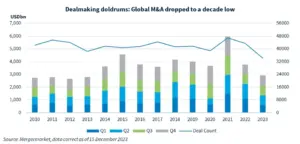
Our analysis of the 2024 business and M&A landscape is framed by the stark visual on the cover: a decade-low in global M&A activity, as reported by Mergermarket for 2023.
This backdrop sets the stage for examining the contrasting views of two experts ~ Brian Levy’s optimism about the market’s potential rebound and Chris van Heerden’s caution regarding continued challenges.
- Optimistic Argument ~ Brian Levy sees the drop in M&A as a setup for a comeback. With the market having bottomed out in 2023, he believes that there’s ample room for growth and recovery. The decline serves as a reset, potentially clearing the way for a more strategic and value-driven M&A environment in 2024.
- Cautious Argument ~ Conversely, Chris van Heerden might interpret the historical low as a warning sign. It suggests that the factors contributing to the slump—geopolitical tensions, economic uncertainties, and regulatory challenges—could persist, making a swift recovery challenging. The data underscores his viewpoint that the M&A market may face a more protracted period of recalibration before witnessing substantial activity.
This graph will be a key visual for our article, encapsulating the recent trends in the M&A market and providing a factual basis for the debate between a potential upturn versus a more gradual recovery.
In the 2024 outlook for business and mergers and acquisitions (M&A), we contrast the insights of Brian Levy from PwC US, who provides an optimistic forecast, with the more cautious predictions from Chris van Heerden at Cadwalader, Wickersham & Taft LLP. Levy predicts a resurgence in M&A driven by financial recovery and strategic business evolution, while van Heerden cautions about potential challenges, including a downturn in fundraising and tighter financial conditions. This juxtaposition of views from two respected professionals offers a balanced perspective on the potential growth and the hurdles of the M&A landscape for the coming year.
Optimistic Outlook on M&A and Business Growth

The accompanying chart above tracks the ebb and flow of M&A deal volume and value from H1’19 through H2’23, setting the stage for the intricate and multifaceted outlook of M&A in 2024. The red bars depict the total number of deals, while the black line charts the value of these deals in US billions, excluding megadeals. This historical data provides context to the current M&A narrative for 2024, which is characterized by a mix of optimistic growth projections and cautious views anticipating potential challenges in the market. |Sources ~ LSEG and PwC analysis | A.J. Arenburg Financial ~ Research Division
The prevailing sentiment among a broad spectrum of experts anticipates a significant resurgence in M&A activities. This optimism is anchored in several key factors that are expected to drive the market forward:
- Financial Market Recovery ~ A stabilization in financial markets is seen as a
foundational element for renewed M&A enthusiasm, with lower concerns about
rising interest rates and recessions. - Untapped Deal Demand and Supply ~ There exists a burgeoning reservoir of
deals, both on the buy and sell sides that were previously delayed or sidelined
due to market uncertainties. - Strategic Imperative for Evolution ~ Businesses are facing a pressing need
to adapt and transform in response to rapid changes in the global business
environment, fueling M&A as a strategic tool for growth and adaptation.
Supporting these factors are insights from leading industry sources like Wolters Kluwer and Quantive, which underscore the readiness of CEOs to engage actively in M&A transactions and navigate through a spectrum of challenges anticipated in 2024.
The Counter-narrative ~ A Cautionary Forecast
In the intricate tapestry of mergers and acquisitions forecast for 2024, a dual narrative emerges. Alongside a stream of optimism for a robust M&A market buoyed by financial recovery and strategic business evolution, there threads a counter-narrative of caution. This cautious perspective is not without merit, as it highlights a series of potential barriers that could significantly impede the pace and success of M&A activities.
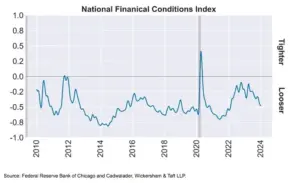
The included image illustrates the National Financial Conditions Index as reported by the Federal Reserve Bank of Chicago in collaboration with Cadwalader, Wickersham & Taft LLP. The line graph displays a timeline from 2010 to 2024, with the index level on the vertical axis indicating the tightness or looseness of financial conditions. Key points of interest include the significant tightening of conditions in 2020, corresponding with the onset of the COVID-19 pandemic, and the subsequent relaxation of conditions to levels suggesting a relatively accommodating financial environment in the lead-up to 2024. | A.J. Arenburg Financial ~ Research Division
The National Financial Conditions Index, as depicted in the graph, is a measure compiled by the Federal Reserve Bank of Chicago that tracks the overall financial conditions in the United States. A lower index value indicates looser financial conditions, while a higher value points to tighter financial conditions.
This counter-narrative underscores the need for a keen awareness of several key factors: geopolitical instability that may inject unpredictability into the market, regulatory challenges that could tighten the reins on deal-making, the pervasive impact of climate change influencing business strategies, and the complexities introduced by technological advancements, particularly in AI, which heighten regulatory scrutiny and cybersecurity issues. These elements collectively suggest an M&A landscape in 2024 that will require companies to exercise enhanced agility, thorough preparation, and a strategic approach to managing a myriad of risks.
- Geopolitical Instability and Regulatory Challenges ~ These factors could
introduce significant uncertainties and complexities into the M&A process,
potentially deterring deal-making activities. - Impact of Climate Change ~ The ongoing and evolving challenges posed by
climate change is expected to influence business strategies and, by
extension, M&A activities, particularly in sectors directly impacted by
environmental regulations and policies. - Increased Regulatory Scrutiny and Cybersecurity Concerns ~ With
advances in technology, particularly AI, businesses must navigate a more
complex regulatory and operational environment, which could influence the
pace and nature of M&A transactions.
These cautionary elements suggest a landscape where agility, preparation, and a strategic approach to risk management will be crucial for businesses looking to engage in M&A.
Navigating Uncertainty ~ A Balanced View on M&A Prospects in 2024
The 2024 M&A outlook is set against a backdrop of volatility, where growth prospects are weighed against persisting global challenges. The market’s trajectory is bifurcated; on one trajectory, experts like Brian Levy from PwC US point to a rejuvenated market catalyzed by stabilized financial conditions, a backlog of deal opportunities, and strategic business transformations. This pathway suggests that the low M&A activity in 2023, as visualized in our cover graph from Mergermarket, might be a nadir from which the market is poised to ascend.
However, this potential ascent is countered by the cautionary insights of Chris van Heerden at Cadwalader, Wickersham & Taft LLP, who draws attention to the lingering geopolitical strife, regulatory tightening, and the shadow of climate change—all of which have historically complicated deal-making and could continue to do so. The graph’s revelation of a decade-low in M&A underscores this perspective, hinting that the path to recovery could be fraught with hurdles that demand strategic navigation.
In sum, the divergent views present a narrative of resilience and adaptability. Businesses in the M&A domain are advised to remain agile, harnessing growth opportunities where possible while bracing for the turbulence that complex market conditions may present. The unfolding year will test the mettle of M&A strategies, potentially distinguishing the adaptable from the static and, in doing so, shaping the new era of mergers and acquisitions.

About A.J. Arenburg Financial
A.J. Arenburg Financial, based in Jacksonville, Florida, specializes in investment banking and advisory services for the industrials, healthcare, and technology sectors. We serve boutique private equity firms, family offices, and organizations with annual revenues exceeding $10 million, focusing on exit strategies for family-owned businesses without succession plans.
We leverage our legal and tax network to provide comprehensive financial advisory services, supporting acquisition strategies and offering full-service assistance for mergers and acquisitions.
Our services integrate investment opportunities with corporate finance advisory, highlighting financial, commercial, operational, and technical due diligences alongside strategic transaction advisory.
Disclosure
The information provided by A.J. Arenburg Financial Equity Research Division is for educational purposes only and is not intended to serve as investment advice. The analysis, views, and opinions expressed represent our assessments as of the date of publication and are subject to change at any time without notice. This document is not a recommendation to buy, sell, or hold any specific securities.
Investors should consult with their financial advisors before making any investment decisions. A.J. Arenburg Financial Equity Research Division and its analysts are not registered investment advisors, and we do not provide personalized or individualized investment advice. Any investment decisions made by the reader based on information contained herein are the sole responsibility of the reader.
The contents of this report should not be construed as an express or implied promise, guarantee, or implication by A.J. Arenburg Financial Equity Research Division that clients will profit from the strategies herein or that losses in connection therewith can or will be limited. Past performance is not necessarily indicative of future results. Investments in securities are subject to market and other risks, and there is always the potential of losing money when you invest in securities.
Neither A.J. Arenburg Financial Equity Research Division nor any of its affiliates, directors, officers, or employees bear any responsibility for any investment decisions made based on information in this report. The reader must independently evaluate the economic risks and merits of any investment decision.
By using this document, the reader agrees to release and hold harmless A.J. Arenburg Financial Equity Research Division from any and all liability concerning the use of this document and/or the information contained therein.
🌐 Sources
pwc.com – Global M&A industry trends: 2024 outlook
wolterskluwer.com – 2024 business and legislative trends for large enterprises
goquantive.com – Market Update and Predictions: 2024
bryter.com – 5 Key Trends in Risk and Compliance in 2024
axios.com – Watch: A conversation on the forecast for M&A in 2024
lexology.com – A Few Thoughts on the “Gloomy” Fundraising Outlook
acg.org – 2024 Economic & Political Outlook on M&A | ACG Los Angeles