

What is my business worth in 2026? Most owners ask this question, but the answer depends on industry, risk, and how well the business is prepared.
In today’s market, two companies with the same $5M EBITDA can sell for $25M… or $45M+ depending on risk, industry, and how well the business is prepared.
This guide breaks down real EBITDA multiples by industry in 2026, what drives them, and how to position your business for a premium valuation.
What Is My Business Worth? How Valuations Actually Work
At a high level, most lower middle market businesses are valued using:
EBITDA × Multiple = Enterprise Value
While methods like Discounted Cash Flow exist, buyers in this market primarily focus on:
- Risk
- Cash flow stability
- Scalability
👉 The multiple is where most of the value is gained, or lost.
Real EBITDA Multiples by Industry (2026)
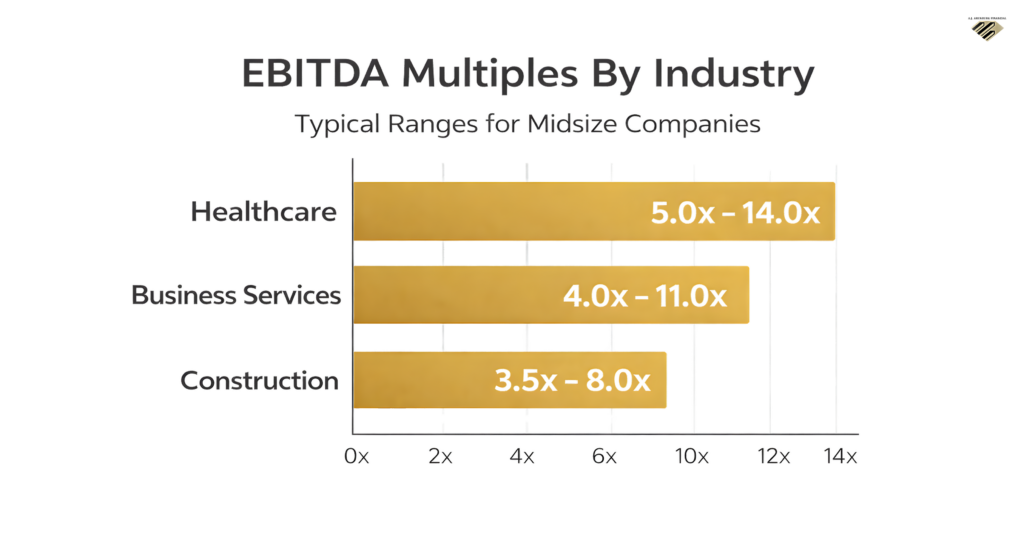
Below are typical ranges we’re seeing in the current market:
Construction & Industrial Services
Construction businesses can trade anywhere from 3.5x to 8.0x+ EBITDA, depending on quality.
What drives value:
- Backlog quality (not just size)
- Margin consistency across jobs
- Customer concentration
- Project vs recurring revenue
👉 Many deals fall apart due to poor financial visibility (WIP issues, inconsistent margins), not a lack of buyers.
🔗 Learn how to clean up your financials before a sale → Learn More!
Healthcare Businesses
Healthcare continues to command premium valuations, typically 5.0x to 14.0x+ EBITDA.
What drives value:
- Recurring / reimbursable revenue
- Provider dependency
- Payor mix
- Multi-location scalability
👉 Private equity demand remains strong due to fragmentation and predictable demand.
Business Services (B2B)
Business services typically trade between 4.0x and 11.0x+ EBITDA.
What drives value:
- Recurring contracts (huge driver)
- Systems and SOPs
- Customer diversification
- Management team in place
👉 Moving from project-based revenue to recurring contracts can significantly increase valuation.
Real Example: $5M EBITDA Business
Let’s break this down:
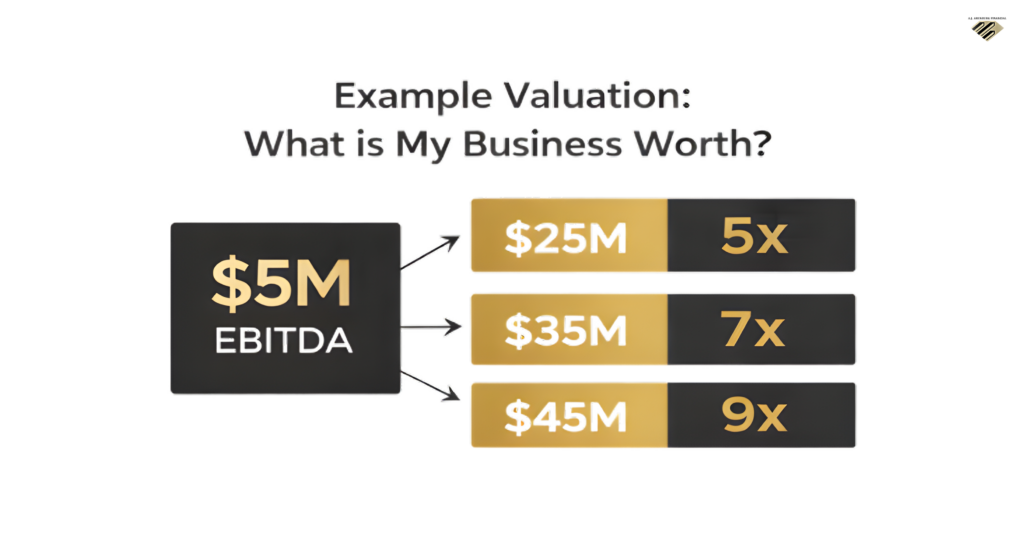
Same business. Different outcome.
👉 The difference is preparation, positioning, and buyer confidence.
What Actually Drives Your Multiple
The multiple isn’t random. Buyers are underwriting risk.
Key factors:
- Clean, accrual-based financials
- Credible EBITDA addbacks
- Low customer concentration
- Strong margins and growth
- Management team (not owner-dependent)
- Recurring or contracted revenue
Why Similar Businesses Sell for Very Different Prices
We see this constantly:
- One business goes to market with messy financials and vague addbacks
- Another is fully prepared with clean reporting and a clear story
The second business attracts:
- More buyers
- Better terms
- Higher multiples
👉 Buyers pay for confidence and clarity.
How to Increase Your Business Value Before Selling
Many owners rely on outdated rules of thumb or informal opinions when estimating value. In reality, buyers evaluate risk, financial quality, and scalability, meaning two similar businesses can have drastically different outcomes in a transaction.
If you’re planning to sell in the next 12–24 months, focus on:
- Cleaning up financials (accrual, normalization)
- Preparing for diligence (QoE-level detail)
- Reducing key-man risk
- Building systems and processes
- Improving revenue quality
🔗 Start with a professional valuation → Learn More!
Should You Sell in 2026?
The market remains active—but more selective than prior years.
High-quality businesses are still commanding strong valuations. Unprepared businesses are getting discounted or not selling at all.
Your business is worth what a buyer is willing to pay—and that number is heavily influenced by how well you prepare.
The difference between a 5x and 9x multiple can mean millions.
Work With Us
If you’re considering a sale or just want to understand your value:
We work with owners to:
- Determine true valuation
- Prepare financials to institutional standards
- Run a disciplined process with qualified buyers
About A.J. Arenburg Financial
A.J. Arenburg Financial is a boutique investment banking and advisory firm focused on lower middle market businesses. We work directly with owners to prepare, position, and execute transactions in a way that holds up under real buyer and lender scrutiny.
Our clients are typically generating $10M to $250M in revenue and $2M to $25M in EBITDA across several sectors of focus, including industrials, construction, business services, and select healthcare and technology sectors. Many are founder-led or family-owned businesses navigating growth, liquidity, or succession decisions.
We advise on sell-side M&A, business valuations, financial due diligence, and capital strategy. This includes Quality of Earnings analysis, normalization of EBITDA, working capital assessment, and building financials that align with how buyers and lenders actually evaluate risk.
Beyond transactions, we support owners ahead of a sale through exit planning and fractional CFO work. That means cleaning up financials, identifying gaps, and positioning the business properly before going to market.
Our approach is hands-on and execution focused. We are not a volume shop. Every engagement is built around presenting a credible, defensible story to buyers and driving a process that gets done.