
Construction is not slowing. It is splitting
In 2026, the industry is no longer moving in one direction. Instead, it is dividing into clear winners and losers, with capital and demand concentrating into a narrow group of sectors. At the same time, contractors are operating in an environment defined by tighter margins, labor constraints, and increasing execution risk. The result is a market where success depends less on overall growth and more on where you operate and how you execute.
The 2026 construction outlook is increasingly driven by capital concentration rather than broad market growth. For owners, the 2026 construction outlook should influence decisions around timing, positioning, and exit strategy.
According to industry data from sources like ENR and the U.S. Census Bureau, construction spending trends are becoming more uneven.
A Slower and More Uneven Environment
The broader construction environment is showing clear signs of strain. While headline growth still appears modest, much of it disappears once inflation is considered. Across many segments, spending is flat or declining, and firms are increasingly dealing with delayed starts, reduced project scopes, and jobs that never move forward.
According to the American Institute of Architects, nonresidential construction spending is expected to grow only slightly over the next several years, with some sectors already experiencing declines. At the same time, data from the Associated General Contractors of America shows that contractors are facing increasing uncertainty around backlog quality, funding availability, and project timing. This is not a collapse in demand, but it is a clear shift toward a more selective and less predictable market.
Demand Is Concentrated, not broad-based
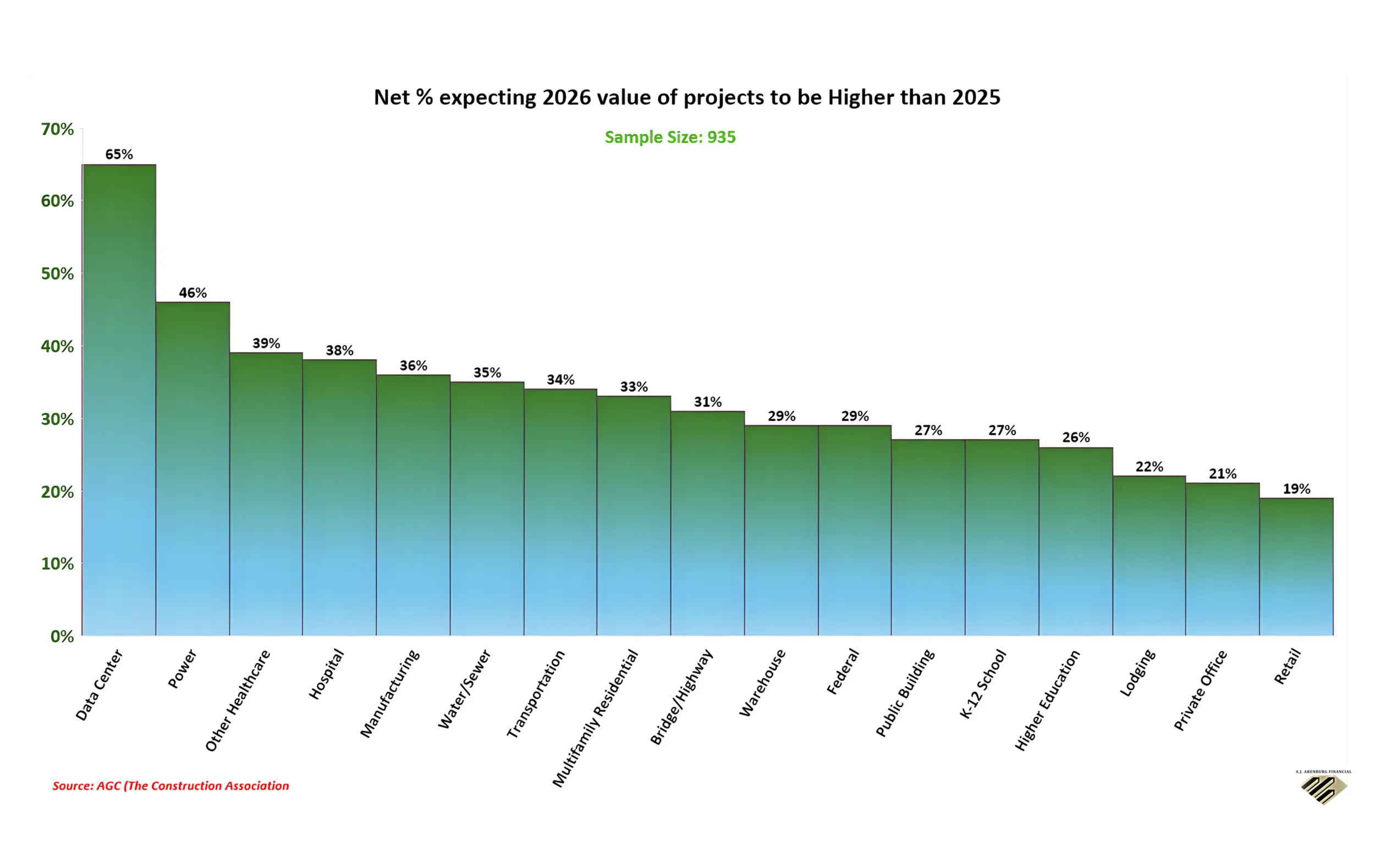
What stands out most in 2026 is not a lack of demand, but how concentrated it has become. Growth is being driven by a small number of sectors, while others remain flat or continue to decline.
Data centers lead the market by a wide margin, followed by power, healthcare, and infrastructure-related segments. In contrast, sectors like office, retail, and lodging continue to struggle, with education and warehousing showing limited momentum. This divergence is clearly reflected in contractor expectations across the industry.
This data highlights a critical point. Contractors overwhelmingly expect stronger project activity in sectors tied to data, energy, and infrastructure, while traditional commercial categories lag behind. The gap between the highest growth and lowest growth sectors is significant, reinforcing the idea that construction in 2026 is not a rising tide. It is a selective flow of capital.
Margins Are Under Pressure from Every Direction
Even in sectors experiencing growth, profitability is becoming harder to maintain. Contractors are dealing with rising labor costs, persistent material pricing pressure, and elevated financing costs driven by higher interest rates. At the same time, competition for projects is increasing, particularly in slower segments where more firms are chasing fewer opportunities.
According to the Associated General Contractors of America, cost pressure and economic uncertainty remain the top concerns for firms entering 2026. Many contractors report projects being postponed, reduced in size, or cancelled due to funding challenges or shifting economic conditions. This combination of rising costs and inconsistent demand is compressing margins and forcing firms to be more disciplined in both bidding and execution.
Labor Constraints Continue to Limit Growth
Labor remains one of the most persistent challenges in the industry. Shortages of skilled workers, limited subcontractor availability, and ongoing concerns around workforce quality are all constraining the ability of firms to scale.
These challenges are not temporary. Demographic trends combined with the industry’s reliance on an aging workforce continue to tighten labor supply. Policy factors, including immigration enforcement, add another layer of uncertainty. Both the American Institute of Architects and the Associated General Contractors of America point to labor availability as one of the most significant long-term constraints on construction activity.
Technology Is Becoming Core to How Work Gets Done
At the same time, the way projects are executed is changing. Technology is no longer just a competitive advantage. It is becoming a core part of how construction businesses operate.
The industry is moving away from disconnected tools and toward integrated systems that provide real-time visibility across projects. Technologies such as BIM, AI-assisted reporting, predictive analytics, and digital twins are enabling firms to make faster and more informed decisions. Platforms like CMiC and CompanyCam are focused on centralizing data, improving coordination, and reducing administrative burden.
Recent survey data shows that adoption is still uneven. While many firms are beginning to use artificial intelligence in areas like estimating and preconstruction, a large portion of the industry has not yet implemented it at all. Adoption today is concentrated in office-related workflows, while field-level applications remain limited.
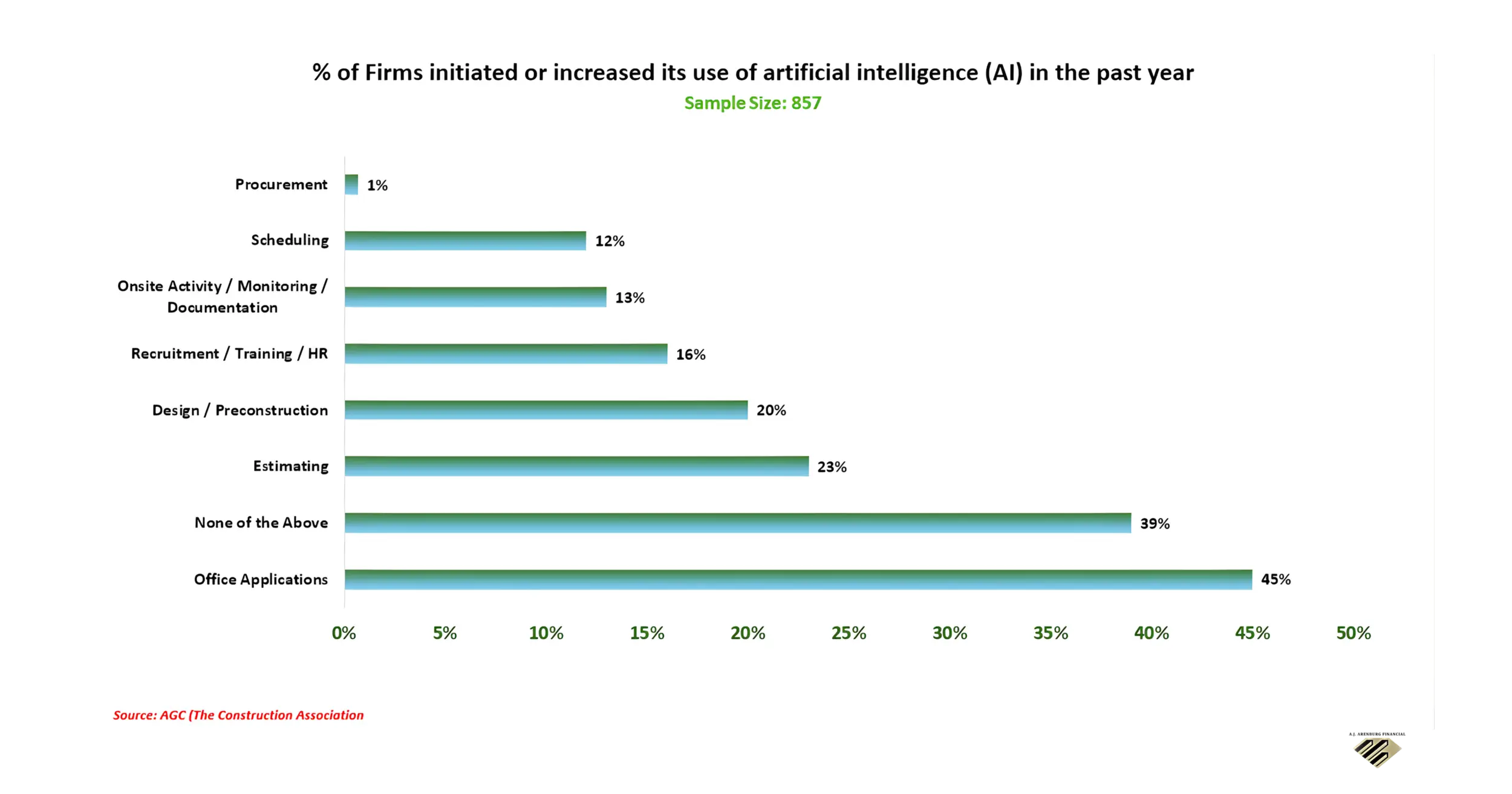
The data reinforces an important point. Artificial intelligence in construction is not yet fully operational. Most firms are applying it to administrative and support functions such as office applications, estimating, and design. In contrast, lower adoption in areas like scheduling, procurement, and onsite execution shows that the industry is still in the early stages of integrating AI into core project delivery.
This gap creates both risk and opportunity. Firms that successfully move AI beyond back office use and into field operations, project tracking, and decision making will have a meaningful advantage in visibility, speed, and execution.
The Firms That Win Will Be More Disciplined
The construction industry in 2026 is defined by two forces. External pressure from rising costs, labor constraints, and economic uncertainty is colliding with internal changes in how projects are managed and delivered.
Success in this environment is not about chasing more volume. It is about selecting the right opportunities, managing risk, and executing with precision. Firms that focus on high-growth sectors, maintain discipline around margins, and invest in systems that improve visibility and control will be in a stronger position to navigate the cycle.
Construction is not slowing. But it is no longer moving together. Understanding the 2026 construction outlook is critical for contractors planning growth, investment, or exit.
About A.J. Arenburg Financial
A.J. Arenburg Financial is a boutique investment banking and advisory firm focused on lower middle market businesses. We work directly with owners to prepare, position, and execute transactions in a way that holds up under real buyer and lender scrutiny.
Our clients are typically generating $10M to $250M in revenue and $2M to $25M in EBITDA across industrials, construction, business services, and select healthcare and technology sectors. Many are founder-led or family-owned businesses navigating growth, liquidity, or succession decisions.
We advise on sell-side M&A, business valuations, financial due diligence, and capital strategy. This includes Quality of Earnings analysis, normalization of EBITDA, working capital assessment, and building financials that align with how buyers and lenders actually evaluate risk.
Beyond transactions, we support owners ahead of a sale through exit planning and fractional CFO work. That means cleaning up financials, identifying gaps, and positioning the business properly before going to market.
Our approach is hands-on and execution focused. We are not a volume shop. Every engagement is built around presenting a credible, defensible story to buyers and driving a process that gets done.
Sources
- CompanyCam
- CMiC
- Associated General Contractors of America
- American Institute of Architects