

As of the closing bell on September 21, 2023, the U.S. stock market displayed a landscape shaped by significant shifts in key indices. The Dow Jones Industrial Average (DJIA) concluded at 34,070.42, reflecting a daily loss of 370.46 points, amounting to a decline of 1.08%. Meanwhile, as represented by the S&P 500, the broader market recorded a closing figure of 4,330.00, marking a substantial decrease of 72.20 points, or 1.64%. Simultaneously, the tech-heavy Nasdaq Composite, mirroring the pulse of the technology sector, closed at 13,223.99, registering a decline of 245.14 points, or 1.82%.
In the financial world, every market level tells a story, and these closing values represent a critical chapter in the ongoing narrative of U.S. equities. These figures provide an essential context for understanding the recent developments in the market, particularly when viewed against the backdrop of the U.S. Market Barometer, a guiding metric for assessing market conditions.
As we analyze these market levels and their implications, we will explore the factors contributing to this notable downturn, examine historical perspectives, and offer strategic insights for investors seeking to navigate the ever-evolving dynamics of the U.S. stock market.
The Implications of Mechanical Selling

In financial markets, the recent turbulence in the U.S. stock market has sparked a conversation about a phenomenon known as “mechanical selling.” For the uninitiated, mechanical selling is an automated process triggered by specific market conditions. Simply put, it’s when sure market participants, such as options dealers and trend-following investors, respond to predefined rules and algorithms rather than make discretionary decisions based on analysis.
Understanding Mechanical Selling
Imagine a scenario where a specific market level, in this case, a significant decline in stock prices, acts as a trigger. When the market crosses this threshold, it sets in motion a sequence of automatic responses from participants with predetermined rules for such situations. These participants might include options dealers, entities providing options contracts to investors, or commodity trading advisors (CTAs) who rely on technical signals for trading decisions.
Implications of Mechanical Selling
Now, let’s take a look at the implications of mechanical selling, which have gained prominence as U.S. equities approach critical levels:
- Accelerated Downside Pressure: Mechanical selling can intensify downward market momentum. When certain thresholds are breached, it leads to a cascading effect as automated systems sell off assets, including stocks. This automatic selling can exacerbate market declines.
- Options Dealers’ Impact: Options dealers, often major financial institutions, play a significant role in this process. When they become net sellers of options contracts due to market conditions, they may respond by selling stock futures. This action, known as being in a “short gamma” state, can further contribute to market weakness.
- VIX Volatility: Mechanical selling can also impact the CBOE Volatility Index (.VIX), which gauges expected stock market volatility. As the VIX rises, it can lead to challenges for those who have sold VIX call options, contracts used to hedge against market declines. This, in turn, can add to market turbulence.
- CTA Influence: Commodity trading advisors (CTAs) who rely on technical signals can contribute to selling pressure when specific market levels are breached. The prevalence of automated trading strategies means that a collective response from CTAs can magnify market movements.
In the context of the recent market developments, these implications of mechanical selling are critical to understanding the dynamics at play. As we move forward, we’ll explore how these automated responses interact with broader market trends, historical data, and investor sentiment to shape the current landscape. We’ll also consider strategies investors can employ to navigate these challenges effectively.

Navigating Market Turbulence with Advanced Strategies
In the intricate world of finance, particularly during periods of market turbulence, investors often turn to advanced strategies to protect their portfolios and potentially capitalize on volatile conditions. Let’s explore some of the most complex and ingenious methods, demystifying them for a broader understanding.
Options Collars & Balancing Risk and Reward
Options collars are sophisticated strategies designed to safeguard a portfolio against significant downside risk while preserving the potential for gains. Imagine it as an insurance policy for your investments. Here’s how it works.
- Logic Simplified: An options collar involves owning a stock, buying a protective put option, and selling a covered call option. The put option acts as insurance, allowing you to sell your stock at a predetermined price if its value drops significantly. Meanwhile, the covered call generates income but caps potential gains. Together, these components create a balanced strategy that provides downside protection without sacrificing all upside potential.

Pairs Trading: Profiting from Relative Price Movements
Pairs trading is like a finely tuned musical ensemble in finance. It’s about identifying two related assets and capitalizing on their price differences. Here’s how this intricate dance unfolds.
- Logic Simplified: Imagine comparing two stocks from the same sector, say Company A and Company B; you notice that historically, when one of these stocks outperforms the other, it tends to revert to the mean. You can initiate a pairs trade by buying the underperforming stock and short-selling the outperforming one. This way, you profit from the convergence of their prices.
Volatility Arbitrage: Profiting from Market Uncertainty
Volatility arbitrage, often seen as the pinnacle of complex strategies, involves navigating the intricate world of options and derivatives. It’s like being a maestro orchestrating an intricate symphony of market movements.
- Logic Simplified: Volatility arbitrage strategies aim to capitalize on implied and realized volatility discrepancies. Opportunities arise when the market expects more significant price swings than what ultimately occurs. One common approach involves selling options when implied volatility is high (and chances are expensive) and repurchasing them when they fall (and options are cheaper). It’s akin to buying low and selling high but in market uncertainty.

Convertible Arbitrage: Capitalizing on Hybrid Securities
Convertible arbitrage is akin to solving a complex puzzle involving hybrid securities known as convertible bonds. It’s like navigating a maze with multiple potential paths:
- Logic Simplified: Convertible bonds are unique instruments that combine features of both stocks and bonds. In convertible arbitrage, investors buy these bonds and short-sell the underlying stock. The goal is to profit from the price difference between the two. If the stock rises, the convertible bondholder enjoys potential upside, but if it falls, the short position provides a hedge.
These advanced strategies are like intricate pieces of art in finance, requiring a deep understanding of markets, complex mathematical models, and a knack for timing. While they may perplex even seasoned experts, breaking them down into more straightforward concepts reveals the genius behind their design. These strategies demonstrate how the financial world can be complex and beautifully structured, offering opportunities for those willing to explore its intricacies.
Unveiling the World of Greeks in Options and Stocks
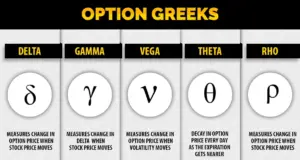
Prepare to embark on a mind-bending journey into the world of Greeks – not the ancient philosophers, but the intricacies of options and stocks. The Greeks are a set of quantitative measures that provide a deeper understanding of how options and derivatives behave. Let’s dig into these mind-bending concepts and explore how they are utilized in the fascinating realm of derivatives.
Delta – The Dynamic Chameleon
Delta is like a chameleon of the options world, constantly changing to adapt to its environment. It measures an option’s price sensitivity to underlying asset price changes.
- Logic Simplified: A call option with a delta of 0.6 means that for every $1 increase in the underlying stock’s price, the option’s price is likely to increase by $0.60. Conversely, for every $1 decrease in the stock price, the option’s price may fall by $0.60. Delta helps traders assess how much their option’s value will change with movements in the underlying asset.
Gamma – The Accelerator of Change
Gamma adds an extra layer of complexity to Delta. It measures the rate of change of an option’s Delta concerning changes in the underlying asset’s price.
- Logic Simplified: Gamma tells us how quickly Delta is changing. Imagine driving a car (Delta) with Gamma as your accelerator pedal. The harder you press the pedal, the faster your car’s speed (Delta) changes. Gamma is crucial for traders managing complex option portfolios, helping them adjust their positions dynamically as market conditions evolve.
Theta – The Silent Time Thief

Theta is the quiet but relentless thief of time in the world of options. It represents the rate at which an option’s value decays as time passes, assuming all other factors remain constant.
- Logic Simplified: Theta quantifies how much an option loses value each day due to the mere passage of time. If an option has a Theta of -0.05, it suggests that its value could decrease by $0.05 every day, all else being equal. Traders and investors use Theta to make informed decisions about when to buy, sell, or hold options.
Vega – The Volatility Whisperer
Vega is your guide through the intricate dance of market volatility. It measures an option’s sensitivity to changes in implied volatility.
- Logic Simplified: Consider Vega as a weathervane for options. If Vega is high, it means the option’s price is susceptible to changes in implied volatility. When the market becomes more volatile, options with higher Vega tend to increase in value, and vice versa. Traders use Vega to gauge how changes in volatility may impact their positions.
Rho – The Interest Rate Sage
Rho is the options oracle of interest rates. It quantifies an option’s sensitivity to changes in interest rates.
- Logic Simplified: Rho helps answer the question: How does an option’s value change when interest rates fluctuate? If Rho is 0.03, it suggests that for every 1% increase in interest rates, the option’s price might increase by $0.03. Understanding Rho is crucial for traders when interest rates significantly affect the market.
Order of Importance
It’s essential to recognize the relative importance of the Greeks:
- Delta is typically the most critical Greek, directly reflecting the option’s price movement concerning the underlying asset.
- Vega comes next, as it gauges sensitivity to volatility changes, which can significantly impact option prices.
- Theta highlights the time decay effect, crucial for managing options expiring soon.
- Gamma is vital for those managing complex options portfolios, as it indicates how Delta changes dynamically.
- Rho is of primary concern when interest rates play a significant role in the market.
Common Myths
Rookie traders often fall prey to common myths and misconceptions about Greeks. They might think Delta alone determines an option’s profitability, ignoring Vega’s impact on volatility changes. Or they may overlook Theta, underestimating how time decay erodes option value.

How the Best Traders Use Greeks
The best traders in the world harness Greeks as part of their decision-making toolkit, not just for options but in general. They recognize that these metrics provide a multifaceted view of risk and opportunity. They use Greeks to:
- Fine-Tune Risk Management: By understanding how Greeks interact, top traders can create diversified portfolios that balance risk effectively.
- Dynamic Position Management: They adjust positions based on changing market conditions, leveraging Delta and Gamma to optimize risk-reward profiles.
- Volatility Trading: Recognizing the importance of Vega, they actively trade volatility, profiting from anticipated changes.
- Time-Value Awareness: Elite traders appreciate Theta’s impact and strategically select options based on their desired time frame.
- Interest Rate Sensitivity: Rho guides decisions in environments where interest rates are pivotal.
In essence, the best traders master the Greeks to navigate the complexities of financial markets comprehensively, enabling them to stay ahead of the curve and make informed decisions in even the most challenging conditions.
Mastering the Greeks for Financial Success
As we closely monitor the asset’s price and adjust my strategy as needed once a position is established, it’s essential to emphasize the holistic perspective they provide for traders and investors. These quantitative measures are not isolated entities but interconnected tools illuminating the financial markets’ multifaceted nature. Understanding Delta’s dual role as a sensitivity and probability indicator, appreciating Gamma’s influence on dynamic option positions, recognizing Theta’s relentless impact on time decay, grasping Vega’s role as the volatility whisperer, and acknowledging Rho’s significance in interest rate environments all contribute to informed decision-making.
For traders and investors, the Greeks are akin to the compass and map in uncharted terrain – they guide you, warn you, and empower you to navigate the complexities of financial markets. While rookie misconceptions and myths may lead some astray, the best traders in the world have mastered these Greeks to gain a competitive edge. They utilize them not as isolated metrics but as a cohesive toolkit for managing risk, optimizing returns, and seizing opportunities in an ever-evolving financial landscape.
About A.J. Arenburg Financial

A.J. Arenburg Financial, headquartered in Jacksonville, Florida, specializes in investment banking and advisory services, focusing on the industrials, manufacturing, and AI-enhanced sectors. Our firm caters to a distinguished clientele, including premier boutique private equity firms, family offices, and entities with substantial annual revenues exceeding $10 million. We are adept at guiding family-owned and multi-generational businesses through sophisticated exit strategies, offering indispensable support for retiring owner-operators lacking succession plans.
Our comprehensive range of services merges exceptional investment opportunities with precise corporate finance expertise. We emphasize operational due diligence and strategic transaction advisory. Our Quality of Earnings Reports (QofE), a vital element of our financial due diligence process, provide essential insights for informed investment decisions. Our team, skilled in managing complex financial scenarios, devises strategic solutions that facilitate significant business transitions. With an extensive network in the private capital markets, A.J. Arenburg Financial commits to delivering efficient and reliable service, reinforcing our status as a trusted advisor for families and institutions on a global scale.