
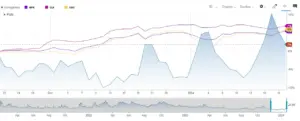
The Volatility Index (VIX), Wall Street’s ‘Fear Gauge,’ is currently signaling an era of investor complacency as it lingers near four-year lows, suggesting that market participants are sanguine about the near-term prospects of equities. This calmness in the VIX could be interpreted as the result of a robust appetite for risk, with many investors seeking to capitalize on what they perceive to be a continuing bull market heading into 2024. However, the wisdom of the crowd can often be misleading, and a low VIX is not without its paradoxes. As the market scales new heights, it may be wise to heed the old adage: “When others are greedy, be fearful.”
Yet, recent market actions suggest a nuanced picture. Investors are indeed splurging on cheap options as hedges, indicating a lurking awareness of potential downturns despite the low volatility environment. This dichotomy between a low VIX and the uptick in hedging activity may point to cognitive dissonance in the market psyche—a preparedness for possible market perturbations even as the surface appears unperturbed.
Grasping the intricate factors that propel market dynamics is essential for trading efficacy. While the allure of day trading as a viable means of income captivates many retail traders, the reality often falls short of expectations. A considerable number of these traders are not adequately equipped with the requisite knowledge or the swift decisiveness needed for this high-stakes arena, which frequently results in ineffective risk management and constrained trading capital. It’s crucial to recognize the significance of account size in this equation, particularly in options trading. The SEC imposes a regulation that limits investors with less than $25,000 in their accounts to a mere three-day trades per week, thereby introducing a liquidity risk and limiting their agility in derivatives trading. Consequently, some traders find themselves in fervent hope for a turnaround on their depreciating options.
Moreover, it’s prudent to note that options with imminent expiration dates often carry elevated risks that are not well-suited for the unseasoned trader; a staggering 80% of such options are rendered valueless at expiration. Echoing the sentiments of Jim Cramer from Mad Money, a significant portion of traders may be surrendering their stakes by misjudging prevailing market currents, frequently under the presumption of a brief engagement in the market. This can lead to scenarios where traders are compelled to increase their market exposure or to enhance their positions, intensifying the challenges associated with liquidity and cash reserves.
In the forthcoming sections, we delve into the nuances of the Volatility Index, or VIX—aptly deemed the market’s barometer of trepidation. This exploration will elucidate how the VIX can be utilized to decipher market trajectories and harness an understanding that extends beyond mere speculation, thereby furnishing investors with a strategic edge in navigating the capricious seas of the financial markets.
THE VOLATILITY INDEX ~ WHEN IN DOUBT, ZOOM OUT
The Volatility Index, commonly known as VIX, is a crucial technical analysis tool that provides valuable insights into the current market conditions. It also may give an idea of future trends in the equity markets. The VIX has an inverse relationship with the S&P 500. This means that as the S&P 500 goes up, the VIX goes down, and vice versa. In this article, we will aim to simplify and provide knowledge that can help in making informed decisions while attempting to understand where the market is heading.
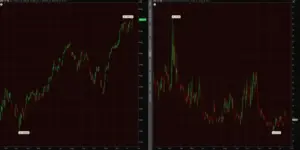
Dissecting Market Sentiments: The VIX and Equity Indices Nexus
An annual overview of market data typically reveals a clear inverse relationship between the Volatility Index (VIX) and major equity indices, a testament to the VIX’s role as the market’s pulse. Yet, a more granular examination across different time spans—monthly or quarterly—uncovers a more complex and subtle trend. Our provision of ‘real-time’ visuals across various periods is designed to shed light on the nuanced interplay between the VIX and the leading indices, enhancing comprehension of their intertwined effects.
Despite its current low, which might be dismissed as inconsequential, the VIX’s subtle upward trajectory against a backdrop of economic and geopolitical tumult—spanning fiscal adjustments, monetary policy shifts, and consumer expenditure trends—should not be underestimated. The juxtaposition of the S&P 500 scaling new heights against the VIX’s lows augurs caution, suggesting the prudent anticipation of a market recalibration in the offing. This year’s electoral dynamics further compound the market’s vulnerability, with the prospect of a Trump reelection injecting additional uncertainty. The ascent in bond yields serves as an additional harbinger of potential market turbulence.
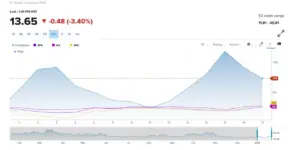
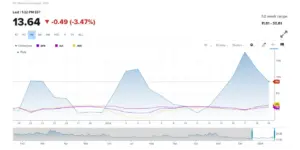
While the market’s zenith may signal a bullish tenor, a discerning analysis raises alarms—could this be a prelude to a strategic positioning for a market downturn? Concerns about border policies and security threats loom as dark clouds over the market’s horizon, potentially catalyzing a corrective cascade. The upward creep of the ‘Fear Gauge’ stands in stark contrast to prevailing market optimism, underscoring the necessity of vigilance. The coming months are pivotal; without significant positive shifts, the market may well exemplify the gravity of the axiom ‘what rises must eventually retreat’. The plotted VIX charts, ranging from daily to yearly snapshots, underline a discernible crescendo of market anxiety, supplanting the lateral movements seen in the previous year. As we approach the critical junction of the November elections, it is incumbent upon market participants to monitor whether this crescendo of concern will continue its ascent.
CBOE Volatility Index.VIX: Year-To-Date (YTD)
CBOE Volatility Index
CBOE Volatility Index.VIX: 1-Month
CBOE Volatility Index
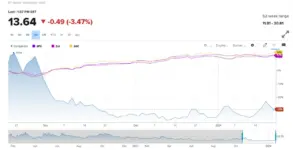
CBOE Volatility Index.VIX: 3-Month
CBOE Volatility Index
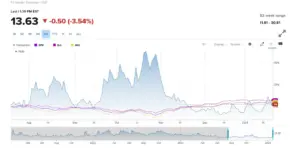
CBOE Volatility Index.VIX: 6-Month
CBOE Volatility Index
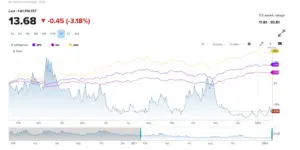
CBOE Volatility Index.VIX: Annual
CBOE Volatility Index
Putting It All Together
The quintet of graphs reveals a comprehensive narrative about the behavior of the Volatility Index (VIX) in relation to major equity indices over varied temporal spans. Analyzing from a year-long perspective down to daily fluctuations, we observe a persistent inverse correlation with the S&P 500, affirming its moniker as the market’s ‘Fear Gauge’. Over the annual timescale, the VIX trajectory has ebbed and flowed, indicating periods of heightened investor apprehension interlaced with moments of comparative tranquility. In the shorter term, the daily charts exhibit sharp peaks and troughs, reflective of more immediate reactionary sentiments to market stimuli. Across all timescales, the volatility index’s movements offer a contrarian harmony to the indices, serving as a barometer for market sentiment. Notably, the VIX’s recent ascension—subtle yet steady—suggests a mounting cautiousness among investors, despite the market’s superficial buoyancy. Such divergence demands scrutiny; it hints at an undercurrent of unease that could precipitate a market recalibration, particularly as macroeconomic and geopolitical landscapes remain turbulent and unpredictable. The graphics stand as a visual testament to the market’s complex dynamics, capturing the nuanced oscillations of investor sentiment that can herald significant shifts in market direction.
The VIX remains a critical tool for assessing market sentiment, but it should not be the sole beacon guiding investment decisions. With analysts signaling caution due to premium valuations and the yield curve movements suggesting a closer inspection of market stability, a balanced view is paramount. Investors would do well to balance the optimism indicated by a low VIX with a strategic consideration of the broader economic and geopolitical horizon that continues to shape market dynamics.
ABOUT A.J. ARENBURG FINANCIAL

A.J. Arenburg Financial, headquartered in Jacksonville, Florida, specializes in investment banking and advisory services, focusing on the industrials, manufacturing, and AI-enhanced sectors. Our firm caters to a distinguished clientele, including premier boutique private equity firms, family offices, and entities with substantial annual revenues exceeding $10 million. We are adept at guiding family-owned and multi-generational businesses through sophisticated exit strategies, offering indispensable support for retiring owner-operators lacking succession plans.
Our comprehensive range of services merges exceptional investment opportunities with precise corporate finance expertise. We emphasize operational due diligence and strategic transaction advisory. Our Quality of Earnings Reports (QofE), a vital element of our financial due diligence process, provide essential insights for informed investment decisions. Our team, skilled in managing complex financial scenarios, devises strategic solutions that facilitate significant business transitions. With an extensive network in the private capital markets, A.J. Arenburg Financial commits to delivering efficient and reliable service, reinforcing our status as a trusted advisor for families and institutions on a global scale.
🌐 Sources
- reuters.com – US stock investors splurge on cheap options hedges with VIX near four-year lows
- mottcapitalmanagement.com – Stocks Finish Lower On January 16, 2024, As The VIX and The Yield Curve Rise Sharply
- nasdaq.com – VIX Index At Three-Year Lows: Does Wall Street’s Fear Gauge Foresee A 2024 Stock Rally
- morganstanley.com – Investors Aiming for Perfection in 2024
- marketwatch.com – The VIX says stocks are ‘reliably in a bull market’ heading into 2024
- cboe.com – VIX Index
DISCLOSURE
The information provided by A.J. Arenburg Financial Equity Research Division is for educational purposes only and is not intended to serve as investment advice. The analysis, views, and opinions expressed represent our assessments as of the date of publication and are subject to change at any time without notice. This document is not a recommendation to buy, sell, or hold any specific securities.
Investors should consult with their financial advisors before making any investment decisions. A.J. Arenburg Financial Equity Research Division and its analysts are not registered investment advisors, and we do not provide personalized or individualized investment advice. Any investment decisions made by the reader based on information contained herein are the sole responsibility of the reader.
The contents of this report should not be construed as an express or implied promise, guarantee, or implication by A.J. Arenburg Financial Equity Research Division that clients will profit from the strategies herein or that losses in connection therewith can or will be limited. Past performance is not necessarily indicative of future results. Investments in securities are subject to market and other risks and there is always the potential of losing money when you invest in securities.
Neither A.J. Arenburg Financial Equity Research Division nor any of its affiliates, directors, officers, or employees bear any responsibility for any investment decisions made on the basis of information in this report. The reader must independently evaluate the economic risks and merits of any investment decision.
By using this document, the reader agrees to release and hold harmless A.J. Arenburg Financial Equity Research Division from any and all liability in connection with the use of this document and/or the information contained therein.