

Mergers and Acquisitions (M&A) are vital mechanisms in the corporate world, essentially involving the amalgamation of companies through diverse transactional forms. This process significantly influences the structuring and dynamics of industries and economies, enabling businesses to expand, diversify, and adapt in competitive markets. M&A activities often lead to the creation of more robust, versatile entities capable of exerting greater influence and operational efficiency within their respective sectors.
The Genesis and Early Years (Late 19th to Early 20th Century)
In the era of the Industrial Revolution, Mergers and Acquisitions (M&A) activities experienced a significant surge, primarily due to the rapid expansion and evolution of industries. This period was marked by the formation of large monopolies and trusts, with major corporations like Standard Oil and U.S. Steel playing pivotal roles in their respective sectors. These entities dominated their industries, leading to concerns about the lack of competition and the potential for market manipulation. In response to these growing monopolistic practices, the U.S. government enacted the Sherman Antitrust Act in 1890. This legislation aimed to curb the power of these monopolies and ensure a competitive and fair marketplace, significantly impacting the business strategies of the time and laying the groundwork for modern antitrust regulations.
The Golden Age of Mergers (1920s)

The 1920s, known as the ‘Golden Age of Mergers’, saw a significant boom in M&A activities, contributing to industrial expansion. This period was characterized by soaring stock prices and widespread investment in the stock market. However, the prosperity of the 1920s ended abruptly with the stock market crash of 1929, a pivotal event that led to the Great Depression. The crash, marked by the rapid fall of stock prices and loss of fortunes, significantly impacted the U.S. economy and slowed down M&A activities. It served as a harsh reminder of the volatility and risks associated with financial markets and had a long-lasting impact on corporate strategies and government regulations.
The Great Depression, beginning with the stock market crash of 1929, was a severe worldwide economic downturn lasting throughout the 1930s. It was the longest and most widespread depression of the 20th century, characterized by widespread unemployment, deflation, and a significant drop in economic activity. During this period, M&A activities were substantially impacted. However, as the economy started to recover, M&A began to play a role in corporate restructuring and consolidation. Companies sought mergers and acquisitions as a strategy to improve efficiencies, reduce costs, and gain competitive advantages in a challenging economic environment. This period of restructuring was crucial for the survival and eventual growth of many firms during the recovery phase of the depression.
Post-War M&A Activity (1940s-1970s)
In the post-WWII era, spanning from the 1940s to the 1970s, the M&A landscape underwent a significant transformation. This period witnessed a resurgence in merger and acquisition activities, characterized by the rise of conglomerate mergers. Companies actively diversified their portfolios by acquiring businesses across various sectors, aiming to reduce risk and capitalize on market opportunities.
During the post-WWII era from the 1940s to the 1970s, the landscape of mergers and acquisitions (M&A) underwent a transformative shift primarily due to significant governmental regulatory changes. These regulatory alterations, particularly notable in the United States, were aimed at promoting fair competition and preventing monopolistic practices within the business environment. One pivotal regulation that played a central role during this period was the Sherman Antitrust Act of 1890, which continued to be a critical tool in regulating M&A activities. This act sought to curb anticompetitive behavior, monopolies, and trusts that could stifle competition in the marketplace.
The impact of these regulatory changes was profound on how companies approached M&A activities. The existence and enforcement of antitrust laws, such as the Sherman Act, necessitated a meticulous consideration of potential antitrust implications in proposed mergers. Companies had to ensure that their mergers did not create monopolistic or anticompetitive situations, leading to heightened scrutiny of M&A deals by regulatory authorities.
As a response to these regulations, companies had to adapt their strategies to comply with antitrust laws. This often meant diversifying acquisitions across different industries to minimize antitrust concerns. Conglomerate mergers, where companies acquired businesses in unrelated sectors, became a common strategy to reduce regulatory scrutiny. Regulatory bodies like the Federal Trade Commission (FTC) and the Department of Justice (DOJ) played a significant role in reviewing and approving M&A transactions to ensure compliance with antitrust regulations.

In parallel, this era also witnessed dynamic changes in job conditions related to M&A activities. Professionals with expertise in finance, law, corporate strategy, legal compliance, financial analysis, post-merger integration, government relations, market research, and economics were in high demand. The post-war M&A activity era presented a dynamic job market with opportunities for professionals with diverse skill sets, all contributing to the complex landscape of mergers and acquisitions during this period.
The Booming 1980s ~ Leveraged Buyouts and Hostile Takeovers
The 1980s ushered in a transformative era in the realm of Mergers and Acquisitions (M&A), characterized by the emergence of Leveraged Buyouts (LBOs) and a proliferation of hostile takeovers. LBOs, a dominant form of acquisition during this period, were defined by their heavy reliance on borrowed funds to purchase companies. The allure of LBOs lay in their capacity to facilitate substantial acquisitions without requiring a significant capital commitment from the acquirer, as the assets of the target company served as collateral. This strategy often resulted in extensive restructuring of the acquired firms, with the primary objective of enhancing efficiency and profitability to service the incurred debt.
LBOs thrived in the 1980s, primarily driven by the availability of junk bonds, which offered higher yields despite greater risk. These bonds allowed companies to raise substantial capital essential for aggressive takeover endeavors. The era witnessed a surge in high-profile buyouts and takeovers that reshaped corporate America in profound ways. The mechanism of LBOs involved acquiring a company using a substantial amount of borrowed funds, thereby placing a significant debt burden on the acquired entity. The subsequent restructuring often aimed to streamline operations, reduce costs, and increase profitability to meet debt obligations.
Parallel to the rise of LBOs, the 1980s M&A landscape was marked by frequent hostile takeovers. In these scenarios, an acquiring company pursued the acquisition of a target company against the wishes of its existing management. Hostile takeovers were frequently facilitated by LBOs, as acquirers used borrowed funds to amass a controlling interest in the target company, often through public tender offers. These aggressive tactics, fueled by the widespread availability of high-risk, high-yield junk bonds, led to significant shifts in industry power dynamics and corporate governance.
Reshaping Corporate America
The combination of LBOs and hostile takeovers during the 1980s resulted in a profound transformation of various industries. Companies subjected to these acquisitions underwent substantial changes in their operations and strategies. While LBOs offered the potential for increased efficiency and profitability, they also carried the risk of excessive debt burdens. Hostile takeovers, on the other hand, challenged established corporate hierarchies and corporate governance norms. The era left an indelible mark on the corporate landscape, shaping the way businesses operate and redefining the dynamics of M&A in the decades that followed.
A Decade of Transformation
The 1980s were a decade of remarkable change in the world of M&A, marked by the ascendancy of Leveraged Buyouts and the proliferation of hostile takeovers. These developments not only redefined the strategies and financial instruments used in acquisitions but also left a lasting legacy that continues to influence the corporate landscape today. Understanding this pivotal period is essential for comprehending the intricacies of modern M&A and the dynamics of corporate control.
The Tech-Driven M&A Wave (1990s-2000s)
The Tech-Driven M&A Wave (1990s-2000s) was a period of transformative consolidation in the technology, media, and telecom sectors, profoundly impacting corporate strategies and market structures. The digital age brought about a surge in strategic partnerships, with companies like Symantec and VeriSign engaging in multi-billion-dollar acquisitions to expand their technological capabilities and market influence. These transactions not only created some of the world’s largest tech conglomerates but also set a precedent for future high-stakes M&A activities.
Reflecting on the legacy of the 1990s and 2000s, the mega-deals by AT&T and Comcast echo the past’s exuberance, evoking memories of the dot-com era’s investment fervor. AT&T’s acquisition of Time Warner and Comcast’s bid for Twenty-First Century Fox, cumulatively valued at $150 billion, is reminiscent of the ambitious expansions and competitive maneuvers that characterized the tech M&A boom. These deals underscore a continued appetite for growth and dominance in the ever-evolving digital landscape, despite the immense financial commitments involved, as evidenced by the considerable debt undertaken by both AT&T and Comcast, making them among the most indebted entities globally.
The trend of leveraging M&A as a strategic tool for growth and adaptation continues to shape the tech industry. It underscores the cyclical nature of M&A waves, driven by technological advancements and the quest for competitive advantage. As companies navigate the challenges of a dynamic global market, the strategies pioneered during the tech-driven M&A wave of the 1990s and 2000s remain as relevant as ever.
The Modern Era (2010s to Present)
In the modern era, particularly from the 2010s to the present, M&A activities have been significantly shaped by digital transformation, AI integration, and varying economic conditions, with a marked focus on strategic mergers, especially in the technology and healthcare sectors.
During this period, the technology, media, and telecommunications sector (TMT) emerged as a dominant force in global M&A activity. In 2021, TMT accounted for 34% of global M&A deal value, a notable increase from 30% in the previous year. This sector’s dominance was marked by the six largest deals of 2021, such as the Discovery-Warner Media merger valued at over $96 billion. This trend reflects the sector’s steady growth over five years, far outpacing other sectors like real estate, industry, energy, healthcare, and financial services in M&A activities.
Global M&A volumes and values experienced fluctuations in recent years. For instance, in 2023, global M&A volumes and values declined by 6% and 25%, respectively, compared to the previous year. This downturn was influenced by factors such as rising interest rates and financing challenges, leading to a 20% decrease in deal numbers between the first and second halves of the year. While deal values improved slightly in the latter half of 2023, overall sentiment among dealmakers remained bearish.
Regionally, Asia Pacific’s M&A volumes and values decreased by 1% and 26%, respectively, in 2023 compared to the previous year. In Europe, the Middle East, and Africa (EMEA), deal volumes declined by 13% in 2023, with deal values falling by 36%, primarily due to fewer megadeals and macroeconomic factors like geopolitical tensions and investor confidence. The Americas also saw a decrease in deal volumes of 3% in 2023.
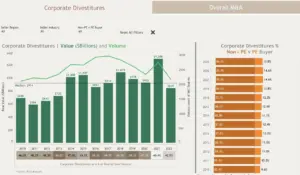
The image above is a chart detailing Corporate Divestitures, showcasing both the value (in billions of dollars) and the volume of deals from 2010 to 2022. The left side of the chart illustrates the annual deal values starting at $586 billion in 2010 and peaking at $1,288 billion in 2021 before a slight decline to $839 billion in 2022. Concurrently, the right side of the chart depicts the percentage of corporate divestitures by non-private equity (PE) versus PE buyers, indicating a consistent trend where non-PE buyers make up the vast majority of divestiture deals, with PE buyers accounting for a smaller portion, though there is a slight increase in PE buyer activity in 2022 compared to 2021.
Incorporating data from the provided search results, the global M&A activity saw a slowdown in 2023, with dealmaking volumes decreasing by 4%. This followed a year where global M&A struggled to keep pace with a record-setting 2021, with aggregate deal values declining by 37% year-over-year in 2022. The total global M&A deal volume finished at $2.9 trillion in 2023.
The trends indicate that while there was a surge in M&A activity in the earlier years, particularly around 2021, the momentum has somewhat tempered in the subsequent years, likely due to various economic and market factors.
Incorporating data from the chart below, sourced from Bloomberg, which focuses on the 2023 deal volumes, we can draw a comprehensive picture of the M&A landscape. The image depicts a bar chart that presents quarterly data for all M&A transactions and controlling-stake M&A transactions from Q1 2014 to Q1 2023. This chart reveals a significant trend: the increase in deal volumes from Q3 to Q4 of 2023 was insufficient to break the $3 trillion mark for the year.
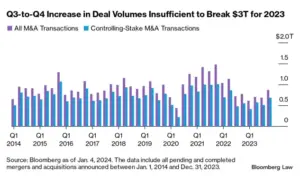
Comparing this with the insights from the earlier provided data, we see that the surge in M&A activities in the earlier years, particularly around 2021, did not sustain its momentum into 2023. Despite a quarter-to-quarter increase towards the end of 2023, the total M&A transactions did not reach the anticipated threshold. This trend aligns with insights from the year-end analysis showing a significant decline in the top 10 M&A deal values in 2023, dropping by over 50% from the previous year, signifying a potential cooling off from the previous M&A fervor.
The overall decline could be indicative of a market correction or a response to macroeconomic conditions, including potential interest rate changes and other market headwinds, impacting the M&A outlook. However, dealmakers have remained engaged, looking towards carveouts, spin-offs, joint ventures, and other innovative deal structures to navigate the changing landscape.
Synthesizing the M&A Epoch ~ Insights and Foresight
The M&A landscape is supported by a comprehensive ecosystem of data and analysis tools. For instance, S&P Global Market Intelligence offers extensive transaction data, including mergers, acquisitions, funding rounds, and bankruptcies, facilitating informed financing decisions and M&A strategies. This includes access to private company data and analysis of credit risk, which is crucial for assessing the risk profile of potential deals.
The M&A landscape in the modern era is characterized by the significant influence of technology and healthcare sectors, regional variations in deal volumes and values, and the crucial role of data and analysis tools in shaping and executing M&A strategies. The dynamic nature of this landscape reflects the ongoing evolution of market conditions, regulatory environments, and technological advancements activities continue to evolve, reflecting the dynamic nature of global economies and technological advancements. They remain a crucial aspect of corporate strategy, influencing market trends and shaping future business landscapes.
Mergers and Acquisitions (M&A) represent critical restructuring strategies in the corporate world, playing a pivotal role in shaping industries and economies. Historically, the late 19th and early 20th centuries marked the beginning of M&A activities, propelled by the Industrial Revolution. Monopolies and trusts dominated this era, prompting government intervention with regulations like the Sherman Act. The 1920s, known as the Golden Age of Mergers, saw M&A contributing to industrial growth, but the market crash in 1929 dramatically slowed this momentum.
The post-World War II period saw a resurgence of M&A, characterized by conglomerate mergers influenced by evolving regulatory landscapes. The 1980s experienced a surge in leveraged buyouts and hostile takeovers, facilitated by the availability of junk bonds, leading to significant market transformations. The 1990s and 2000s were defined by a tech-driven M&A wave, with significant cross-border transactions and technology companies expanding through acquisitions, such as the notable purchases by Symantec and VeriSign.
The modern era continues to experience M&A activities, now influenced by digital transformation, private equity, and global events like the COVID-19 pandemic. ESG considerations have also become a focal point. The landscape of M&A is consistently evolving, with technology and economic factors driving trends and shaping the future of corporate transactions. This evolution offers valuable insights and takeaways for investment and corporate finance professionals navigating the M&A domain.
About A.J. Arenburg Financial

A.J. Arenburg Financial, a Florida-based firm, specializes in investment banking and advisory services for the industrials, healthcare, and technology sectors. We prioritize complex transactional due diligence and serve as a trusted intermediary and partner to family offices, private wealth management firms, boutique private equity firms, and generational organizations with revenues exceeding $10 million. We focus on exit strategies for family-owned businesses with a succession plan or without succession plans.
In addition, our integrated services provide clients with control and transactional cost mitigation. Leveraging our extensive legal and tax network, we offer comprehensive financial advisory services, facilitate acquisition strategies, and deliver full-service assistance for mergers and acquisitions. Our approach combines investment opportunities with corporate finance advisory, including financial, commercial, operational, and technical due diligences, alongside strategic transaction advisory.
Disclosure
The information provided by A.J. Arenburg Financial is for educational purposes only and does not constitute investment advice. Our analysis, views, and opinions are based on assessments made at the time of publication and are subject to change without notice. We do not recommend buying, selling, or holding any specific securities.
Investors should seek advice from their financial advisors before making any investment decisions. A.J. Arenburg Financial and its analysts are not registered investment advisors and do not offer personalized investment advice. Any investment decisions made based on this information are solely the responsibility of the reader.
This report does not guarantee profit or limit losses, and past performance is not indicative of future results. Investing in securities carries inherent risks, and readers should carefully evaluate the risks and benefits of any investment decision.
A.J. Arenburg Financial and its affiliates, directors, officers, or employees bear no responsibility for investment decisions made based on this report. By using this document, the reader agrees to release A.J. Arenburg Financial from any liability associated with its use.

🌐 Sources
- ncu.libanswers.com – M&A Information
- wolterskluwer.com – 2022 M&A Trends
- statista.com – U.S. M&A Statistics
- library.answers.nyu.edu – M&A Resources
- pwc.com – Global M&A industry trends: 2024 outlook
- spglobal.com – Global M&A by the Numbers: 2022 in Review
- M&A Activity by Year: The BCG M&A Report Collection
- imaa-institute.org – M&A Statistics by Countries
- bloomberglaw.com – ANALYSIS: Despite Q4 Boost, 2023 M&A Deal Volumes
- statista.com – Monthly volume of M&A deals in the U.S. 2022-2023
- The Biggest Tech Mergers and Acquisitions of All Time
- Commentary: M&A “mega deal” frenzy evokes 1999 tech boom … and its aftermath?