

Dow Jones Industrial Average’s Resilient Performance in the Industrial Sector Landscape

On October 5, 2023, the Dow Jones Industrial Average (DJIA) displayed a modest increase, closing at 33,129.55, reflecting a 0.03% uptick from the previous day’s close of 33,119.57. This marginal fluctuation in the DJIA’s closing price signifies a relatively stable trading session, with the index experiencing price swings within a range of 32,941.56 to 33,174.38 throughout the day. Over the past year, the DJIA has exhibited a resilient performance, demonstrating a range between 28,660.94 and 35,679.13, underscoring its ability to navigate economic challenges. Typically, the DJIA sees a substantial average trading volume of about 312,605,781 shares, although the recent session recorded a slightly lower volume of 278,481,996 shares.
These percentage changes in the DJIA’s closing price offer a concise snapshot of its performance on October 5, 2023, providing investors and financial professionals with valuable insights. In light of this performance, several key scenarios could unfold.
Firstly, the DJIA’s capacity to maintain stability suggests market resilience, indicating investor confidence in the industrial sector’s prospects and the broader economy. Secondly, fluctuations within the day’s trading range may signify shifts in investor sentiment, warranting further analysis to determine their short-term or long-term implications. Thirdly, the DJIA’s performance serves as a vital economic barometer, with a stable or slightly positive closing price potentially reflecting confidence in the overall economic health.
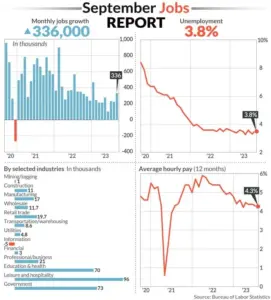
Jobs report shows big 336,000 gain in hiring in September. Labor market still hot. – MarketWatch | A.J. Arenburg Financial Equity Research
Navigating the Industrial Sector ~ The Impact of Quantitative Job Growth
In the industrial sector, precision is paramount for navigating recent developments quantified by a robust jobs report. This quantitative data reveals a resilient labor market, adding an impressive 336,000 jobs last month, September 2023 —far exceeding expectations.
These numbers wield substantial implications for the sector, particularly in the context of the Federal Reserve’s ongoing battle against inflation. In this data-driven landscape, investors and financial professionals must harness their analytical prowess to decode the quantitative signals that will ultimately shape the sector’s trajectory.
Recent developments have ushered in a wave of change in the industrials sector, significantly impacting investment considerations. The stock market currently exudes optimism, fueled by the anticipation surrounding the monthly US jobs report. This report holds immense sway over investors as it could substantially influence the Federal Reserve’s stance on interest rates. All eyes are on labor market indicators, looking for signs of cooling that could provide a compelling case for the Fed to hit the pause button on its ongoing interest rate hikes.
A crucial aspect of this landscape is the behavior of long-term bond yields. Federal Reserve official Mary Daly has hinted that stable yields may render further rate hikes unnecessary. Recent fluctuations in bond yields have captured the attention of financial experts, and their stability or volatility could send ripples across the sector.
The energy market has not been immune to these shifts, with concerns about global economic growth exerting downward pressure on oil prices. This has led to oil prices experiencing their most significant weekly decline since March. These fluctuations can have far-reaching implications for investments in the industrials sector, especially for companies with heavy reliance on oil and energy-related markets.
Challenges in the Automotive Industry ~ Financial Turbulence

Smart. Rugged. Capable. 2024 F-150® Pickup
Amid the intricacies of the industrials sector lies the automotive industry, home to giants like Ford, General Motors, and Stellantis. Here, challenges loom large, and one particular issue commands scrutiny. The rising cost of financing for US consumers purchasing new cars. A striking statistic reveals that one in five borrowers have monthly payments exceeding $1,000. This financial strain stems from surging interest rates and the burden of costly inventory, rendering vehicles less affordable. The loan interest rate, averaging 7.4 percent in the third quarter, has hit its highest point since 2007. Automakers are at a crossroads, with the average monthly payment reaching a record $736 and nearly 18 percent of car buyers committing to at least $1,000 monthly. This trend influences consumer choices and casts a shadow over automakers’ profitability, potentially shifting the demand dynamics in various vehicle categories.
Impact on Consumer Behavior ~ The increasing cost of financing for new cars significantly affects consumer behavior within the automotive sector. With growing borrowers facing monthly payments exceeding $1,000, consumers may opt for more economical and affordable vehicle

options. This shift in consumer preferences can affect automakers’ product strategies, potentially leading to increased demand for smaller, fuel-efficient vehicles and a decreased appetite for larger, more expensive models like SUVs and trucks. This trend could prompt automakers to reassess their product offerings and adapt to changing consumer demands, influencing the composition of their vehicle portfolios.
Pressure on Profit Margins ~ The rising cost of financing impacts consumers and places substantial pressure on automakers’ profit margins. As interest rates surge and monthly payments increase, automakers may be compelled to offer incentives, discounts, or favorable financing terms to attract buyers and remain competitive. These incentives can erode profit margins and impact the financial health of automotive companies. Additionally, automakers may need to explore innovative strategies to manage their inventory effectively in response to changing consumer demand. Balancing profitability with affordability in this challenging financial landscape becomes a critical consideration for industry giants like Ford, General Motors, and Stellantis.
VinFast’s Ambitious Expansion and Financial Strategy

Financial POV from Vietnam Investment Review: VinFast’s Ambitious Journey in the Electric Vehicle Industry
On the international stage, Vietnamese electric vehicle manufacturer VinFast emerged as a prominent player in the industrials sector. The company’s financial report reveals substantial losses, surpassing $5 billion since 2021. VinFast, however, is on an aggressive global expansion trajectory, with the United States at the center of its plans. At the core of VinFast’s global aspirations is its first foreign factory—a projected $4 billion manufacturing and assembly plant in North Carolina, marking the largest incentive-backed private economic initiative in the state’s history. Achieving its hiring and investment targets would make VinFast eligible for significant state incentives, solidifying its position in the US automotive market.
VinFast is actively seeking additional capital to fuel this expansion, expecting to secure $1.2 billion over the next six months. Sources include its parent company, Vingroup, and the sale of company stock. This strategic move underscores VinFast’s determination to establish a foothold in global EV markets. Despite substantial losses, VinFast’s expansion strategy remains resolute, aiming to establish a presence in as many as 50 countries by the end of the following year. The company’s financial performance and expansion initiatives warrant continued vigilance within the industrials sector.
The industrials sector is undergoing profound transformations and encountering formidable challenges, all of which have profound implications for investors and financial professionals. The focal points are the labor market dynamics, interest rate movements, oil price volatility, automotive industry woes faced by Ford, General Motors, and Stellantis, and the adoption of stakeholder capitalism. Simultaneously, the financial performance and expansion strategies of companies like VinFast are central to shaping the sector’s landscape. As the industrials sector continues to evolve, astute analysis and adaptability will be indispensable for making informed investment decisions.
About A.J. Arenburg Financial

A.J. Arenburg Financial, headquartered in Jacksonville, Florida, specializes in investment banking and advisory services, focusing on the industrials, manufacturing, and AI-enhanced sectors. Our firm caters to a distinguished clientele, including premier boutique private equity firms, family offices, and entities with substantial annual revenues exceeding $10 million. We are adept at guiding family-owned and multi-generational businesses through sophisticated exit strategies, offering indispensable support for retiring owner-operators lacking succession plans.
Our comprehensive range of services merges exceptional investment opportunities with precise corporate finance expertise. We emphasize operational due diligence and strategic transaction advisory. Our Quality of Earnings Reports (QofE), a vital element of our financial due diligence process, provide essential insights for informed investment decisions. Our team, skilled in managing complex financial scenarios, devises strategic solutions that facilitate significant business transitions. With an extensive network in the private capital markets, A.J. Arenburg Financial commits to delivering efficient and reliable service, reinforcing our status as a trusted advisor for families and institutions on a global scale.